Reza Negarestani
from Intelligence and Spirit
1. Between Conception and Transformation
IT IS ONLY WHAT IT DOES
This book argues, from a functionalist perspective, that mind is only what it does; and that what it does is first and foremost realized by the sociality of agents, which itself is primarily and ontologically constituted by the semantic space of a public language. What mind does is to structure the universe to which it belongs, and structure is the very register of intelligibility as pertaining to the world and intelligence. Only in virtue of the multilayered semantic structure of language does sociality become a normative space of recognitive-cognitive rational agents; and the supposedly ‘private’ experiences and thoughts of participating agents are only structured as experiences and thoughts in so far as they are bound up in this normative—at once intersubjective and objective—space.
In this cursory sketch the reader may recognise Hegel’s characterization of Geist or Spirit.1 Indeed, Hegel was the first to describe the community of rational agents as a social model of mind, and to do so in terms of its function. The functional picture of geist is essentially a picture of a necessarily deprivatized mind predicated on sociality as its formal condition of possibility. Perception is only perception because it is apperception, and apperception is only apperceptive in that it is an artefact of a deprivatized semantic space within which recognitive-cognitive agents emerge as by-products of a deeply impersonal space which they themselves have formally conditioned. The intertwining of semantic structure and deprivatized sociality enables mind to posit itself as an irreducible ‘unifying point or configuring factor’2
that extends into, encompasses, and integrates both consciousness of itself and consciousness of the universe. In conceiving itself as the configurative or structuring consciousness of itself in the world (or universe), mind is endowed with a history rather than a mere nature or past. It becomes an artefact or object of its own conception. Where there is the possibility of having a history, there is also the possibility of having not only the concept of the concept, but also a history of history—a critical transformation of mind as an object of its own concept, and the critical reconception of the object into which it has transformed. And once there is a history of history, there is the possibility of abolishing what is given in history or purports to be its consummate totality.
My aim in this book, however, is not to remain authentically faithful to the philosophy of Hegel, or that of German Idealism—or for that matter to any other philosophy or philosopher. Philosophy is ‘its own time apprehended in thoughts’,3 and for a large part the activity of philosophizing consists in remodelling philosophical thoughts in accordance with the contemporary moment and its historical needs. To this end, my interpretation of any philosopher in this book follows what Jay Rosenberg calls a ‘Dionysian approach’4 which, in contrast to the Apollonian approach, does not abide by historical accuracy or result in faithful treatises, but instead sees the positive insights and theses of philosophies distortedly through the lens of the contemporary. The Dionysian approach then goes on to selectively but critically mutate, re-engineer, and integrate what it has thus distortedly viewed through the contemporary optic. It is not that the Apollonian approach is the preserve of self-disciplined scholars of history rather than the proper work of philosophers; it is as genuine an exercise in philosophy as Dionysian critical adventurism. In fact, it is a necessary requirement for the sustenance of Dionysian roaming; and the latter, in turn, opens up new terrains of thought to renewed Apollonian scrutiny.
It is in this Dionysian spirit that the book examines and reconstructs the premises and conclusions of the functional picture of mind so as to build a philosophy of intelligence. As we shall see, mind is ultimately understood as the dimension of structure, or a configuring factor; something which can only be approached via an essentially deprivatized account of discursive (linguistic) apperceptive intelligence. The nature of this investigation and reconstruction originates as much from the viewpoint of contemporary philosophy as from that of the cognitive sciences—specifically, the programme of artificial general intelligence (AGI) or human-level AI, and contemporary philosophy of language as an intersection between linguistics, logic, and computer science.
In tandem with the Dionysian approach, the tone, pace, methods, and objectives of the chapters necessarily vary. All in all, this book is a rudimentary attempt to undertake the urgent task of presenting a philosophy of intelligence in which the questions of what intelligence is, what it can become, and what it does can be formulated. In the context of a philosophy of intelligence, this book also attends to the crucial question of what it means for us—humans—to remain faithful to what we are, to remain intelligible at least to ourselves here and now, and in doing so, to become part of the veritable history of intelligence.
The present chapter, which is more of a preamble—a rough sketch—provides an outline of a functionalist and deprivatized account of mind, or geistig intelligence,5 setting down premises that will be spelled out and elaborated more conclusively in the chapters that follow. Introductory yet densely compressed, this chapter encapsulates the overall content of the book. Subsequent chapters unpack this content, at times in a plain demonstrative manner, on other occasions by taking it to its not-so-explicit conclusions.
Chapter 2 begins with an inquiry into the necessary conditions for the realization of geistig intelligence in the form of a program of artificial general intelligence, as if what we were really doing was attempting to construct an
artificial general intelligence. A conceptual framework will be proposed for conducting this as if-thought experiment. Our main objective is not to investigate the possibility of constructing an artificial general intelligence or to review the popular narratives of posthuman superintelligence, but to think about AGI and, even more generally, computers, as an outside view of ourselves. This is an objective labour, so to speak, whereby AGI or computers tell us what we are in virtue of what we are determinately not—i.e., contra negative theology or the uncritical and merely experiential impressions of ourselves. This objective picture or photographic negative may be far removed from our entrenched and subjectivist experience of ourselves as humans. But this rift between the outside view and the experiential impression is exactly what heralds the prospect of future intelligent machinery and a genuine thought of the posthuman.
On the basis of this thought experiment, chapter 3 sets out to investigate the conditions necessary for the possibility of having mind. In this chapter the focus is largely on what might be called the Kantian dimensions of the realization of the discursive apperceptive self (an experiencing and thinking agent), namely intuition, imagination, and a pure perspectival encounter with the world. Chapter 5 continues the mission of chapter 3, but with the focus shifted to the realization of the ‘discursive apperceptive’ aspects of geistig intelligence, moving from the realm of pure perspectivality to that of objectivity, where thought and beliefs have an epistemic status.
In between them, chapter 4 should be approached as a critical excursus that stirs things up somewhat, and prepares the conclusions reached by chapter 3 for their speculative extrapolation in the final chapter. Its focus is the question of temporality and forms of intuition (transcendental aesthetics) as the organizing factors of experience, a question whose proper formulation will lead us to a new perspective not only on experience but also on the model of the minded subject and the prospects of intelligence as time itself.
In chapters 6 and 7, which present the last stages of the thought experiment, we shall examine language as the dasein of geist, inquiring into its sociality and syntactic-semantic complexity in a vein that is much closer to theoretical computer science—with its capacity to integrate computation, mathematics, logic, and language—than to classical philosophy of language
or social-communicative philosophy of rationalism à la Habermas. This investigation will allow us to conclude our examination into the necessary conditions for discursive apperceptive intelligence, an intelligence which acts in conformity with time-general thoughts determined by the conception it has of itself.
In the eighth and final chapter, both artificial general intelligence and the functional deprivatized account of the mind are suspended (aufheben) in a form of intelligence which is at once philosophy and a craft of philosophy qua specific program of thinking that has no nature, but only a history: a model for a self-cultivating intelligence.
A final note: with respect to the distinction between analytic and continental philosophy—of which there is no trace in this book—I have gradually learned to become blind to this supposed divide. The ambitions of philosophy are far too vast and comprehensive for them to be pigeonholed into cosy compartments.
If we were to outline the overall progression of the book in reverse order, as if we had already attained its ultimate conclusions, it could be formulated as follows: Philosophy as the organ of self-cultivation of intelligence is, in the broadest sense, a historical program for investigating the consequences of the possibility of thinking and having mind. The constitutive gesture of philosophy is critical self-consciousness, primarily the non-empirical consciousness of the possibility of thinking as a building block of theoretical, practical, and axiological significance upon which the systematic relations between intelligence and the intelligible can be elaborated, in theory and practice. However, the critical self-consciousness that brings about the possibility of philosophy in the above sense is itself the consequence of the realization of the order of conception or, more generally, self-consciousness as the form or logical structure of all thoughts. Yet the capacity to have thoughts or to inhabit the general order of self-consciousness itself depends upon the fulfilment of the conditions or positive constraints necessary for the realization of mind. Therefore, the speculative inquiry into the future of intelligence—understood as that which expands and acts on intelligibilities
pertaining to itself and to the world of which it is a part—begins with an investigation into the conditions necessary for the possibility of having mind. Whether framed as the program of artificial general intelligence or as a transcendental psychology, the examination of the necessary conditions for having mind marks out a sui generis form of intelligence whose process of maturation coincides with its understanding and elaboration of the link between intelligence and the intelligible. Becoming cognizant of this link is what counts as the genuine expression of self-consciousness as a task whose first milestone is intelligence’s retrospective recognition of its own conditions of realization. Only once intelligence begins to systematically understand its place within the world as an intelligible unity, can it begin to concretely know what it is in itself and what it may become for itself.
The significance of the functional picture of geist is that it enables a thoroughgoing analysis of essentially self-conscious creatures: what activities, in what sorts of structures, are required in order to realize a self-conscious rational agent, or a community of such agents? It is the functional description of discursive, conceptual, and historical geist in the context of those activities that characterize it, but also constitute it in the first place. It sets forth a project wherein the theoretical and practical desacralization of the mind as something ineffable and given coincides with the project of historical emancipation and the disenthrallment of intelligence as that which both frees itself—piece by piece—from its local and contingent limitations (emancipation as a negative freedom from something) and treats whatever conception of itself it has arrived at, whatever task such a conception entails, as the milieu of an unrestricted attention and commitment (emancipation as a positive freedom to do something).
Characterizing discursive consciousness in an adequate functional context—rather than by reference to a predetermined structure or a meaning inherent in nature—makes it possible to identify those necessary conditions for the realization of mind as an intelligence that has not just a history, but a critical history (a history of history), not just a conscious self but, more importantly, a self that is the artefact of its own configuring or unifying Concept (Begriff). This is a self in which the distinction between the subject of conception and the object of the concept is suspended. Moreover, as will
be elaborated in subsequent chapters, this functional characterization offers insights into what it means to reorient consciousness and thought toward an emancipatory project, the core of which is the emancipation of cognition itself.
Before proceeding, it is crucial to add a brief note on the concept of suspension. Throughout this book, I have used the word ‘suspension’ or the verb ‘suspend’ as a common English equivalent for Hegel’s aufheben or aufhebung, instead of the uncommon ‘sublation’ (from the Latin sublatum), which only captures a limited range of the connotations Hegel has in mind. Aufheben has four connotations depending on the context: (1) to lift up or to heave (heben) as if something is on or has fallen to the ground; (2) to pick up or actively seize something, which accentuates the previous connotation (aufheben); (3) to preserve or retain something; (4) to cancel or abolish something, to remove or take out of action. Hegel’s aufheben places the emphasis on the positive and negative connotations (3) and (4). For example, in the case of the pure introspective I, the I that appears to be immediate is in fact mediated by its relations with others; its immediate positedness (Gesetztsein) is the result of (i.e., is mediated by) the movement of positing (Setzen). Through aufhebung, the positive immediacy of the self-reflexive I is cancelled, while the determinate negativity that accounts for the difference between the immediate and its mediation (I and another I) is preserved. In other words, the identity of what appears to be immediate is abolished or taken out of action, whereas the difference between the immediate and its mediation (the opposition) is preserved. Accordingly, Hegel’s aufhebung has both a temporal and spatial aspect: what appears to be immediate prima facie is taken out of action or postponed (the temporal aspect) only to preserve the difference between the immediate and its mediation on an elevated level (the spatial aspect), as in the suspension of Being and Nothing in the more stable Determinate Being.6 Therefore, aufhebung is closely associated with the extended labour of determinate
negation, as opposed to the abstract or indeterminate negation that inadvertently ends up perpetuating the purported immediacy of the state of affairs it seeks to abolish.
A certain X appears to be the completed totality of the state of affairs. X might be the human condition, the manifest totality of ways in which we appear to ourselves as a species; or it might be capitalism, the putative totality of all social relations as transformed by the accumulation of value qua labour time. Through aufhebung the particular content of X is cancelled, but the difference between the immediacy of X and its mediation is retained. This allows us to see the cancellation of X not as a single punctual act that abstractly or totally negates the state of affairs, but as a development, the product of a positive labour of determinate negation that takes time. The suspension of the self-portrait of the human or of the capitalist mode of production as the alleged immediate totality of the state of affairs is thereby differentiated from naive forms of posthumanism, antihumanism, and simple abolitionist revolutionary politics—a revolutionary politics in which negation is decoupled from the process of determination and instead is turned into a fetishized form of abstract negation which, in its indeterminacy, presupposes a metaphysical account of totality whose immediacy is actual and which therefore, it is falsely assumed, can be abolished by an all-destroying and total negation.
In this respect, in addition to determinate negation, aufhebung is associated with Hegel’s distinct concepts of speculation and reason. Speculation is to be contrasted with simple reflection, which is reflection through and on that which is allegedly immediate—for example, what it means to be human is often taken as something immediately present and thus left unexamined. Speculation rescues reflection from its pitfalls rather than annihilating it. Speculation can be grasped as a movement from the subjective to the objective, a movement that suspends the immediate element of reflection and, in doing so, incorporates reflection as the reflection of opposites, a developmental stage in speculation. In the same vein, Hegel’s reason (Vernünftige) is distinct from Kant’s reason, the faculty of concepts and judgements (Vernunft). Hegel’s reason is a form of thinking that admits of the unity and identity of opposites (e.g., both finite and infinite, subject
and object, in their distinctness) and which, rather than operating externally on concepts, explicates the immanent operation of the Concept itself.
Lastly, although distinct from it, Hegelian suspension can be linked back to the Pyrrhonian sceptical epoché or suspension of judgment regarding non-evident propositions. What gives rise to epoché is equipollence or Pyrrhonian isostheneia—the idea that, for any proposition or property, its contradicting opposite or incompatible property can be put forward with equal justification. Hegel’s aufhebung seeks to break from the stasis and practical untenability of Pyrrhonian scepticism by directly assimilating it into reason in such a way that scepticism is no longer idly opposed to reason but becomes a dynamic and productive vector of it—what Ray Brassier has called a ‘dialectics between suspicion and trust’.7 The phenomenal knowledge of geist can therefore be presented as a ‘self-consummating skepticism’.8 The assimilation of epoché into reason and its complete remodelling as the dynamic process of suspension and determinate negation then allows us to think of epochs or, more generally, the history of geist. In order to refine The formal figure of the human or the functional picture of the mind cannot be refined, nor can they shed their entrenched dogmas, without a rational scepticism about their status here and now, and how this status might as a matter of fact restrict the prospects of what mind or intelligence can be. Therefore, it is in this vein that what is introduced in
this book as the critique of the transcendental structure is suggestive of both the operation of Hegelian suspension and the productive incorporation of scepticism into the phenomenology of mind and into the transcendental project which sets out to investigate the functional picture of mind and the figure of the human.
The account of function that is attributed to the mind (as regards what it does, its activities) should and will be elaborated carefully. For now, it suffices to say that this is a normative ‘rule-governed’ account of function rather than a metaphysical one. The function of mind is structuration: conceptualization, rendering intelligible, making objective. The claim here is that there are no intrinsic functions in nature; all metaphysical functions are in fact modelled on normative activities of the mind. This point was already made very clearly by Kant in the context of ‘as if’ arguments: functions in nature are species of ‘as if’ judgements. For example, when we study the heart, it is in regulative analogy to practical reasoning that we say that ‘the function of the heart is to pump blood’. But what we are actually doing is treating the heart as part of a whole (the circulatory system) in terms of means-ends relations: the causal role (means) of the heart is to pump blood in the circulatory system as its end. In accordance with the success or failure of this means-ends relation, which is a piece of practical reasoning, we can then talk about the function or malfunction of the heart (what it ought to do and what it ought not). So, in reality, what we are saying is that, in analogy to practical reasoning, it is as if the function of the heart is to pump blood.
So long as this ‘as if’ aspect is carefully posited and is not confounded with a constitutive judgement, it is not problematic to attribute functions to the activities of natural things. Moreover, functions can only be attributed to activities, not to things. Activities are specific, contextual, and domain-sensitive. Does a lump of clay or the planet Jupiter have a function? Any positive answer to this question risks infinite regress, in so far as it will no longer be possible to specify where the function ends.9 Mind is not a thing: it is only what it does.
In attempting to provide a functional description of mind, I shall try to steer clear of any orthodox or metaphysical functionalism. Nevertheless, despite its metaphysical slipperiness, contemporary functionalism has contributed invaluable insights regarding the problem of functional analysis. These insights are drawn from the epistemological methods required to study complex systems, particularly nested hierarchical structures where the problem of different scales or levels is of the utmost importance.10 In tackling the problem of analysing the mind, some of these methods will be adopted in order to develop a more fine-grained paradigm of functional analysis. Before coming back to a more comprehensive description of geist in terms of its function, then, it will be worthwhile to provide some brief comments regarding the kind of functionalism or functional analysis this book draws upon.
FUNCTIONS AND MULTILEVEL STRUCTURAL CONSTRAINTS
To define or analyse the mind in terms of functions is tantamount neither to the elimination of structural or material constraints, nor to a dismissal of such constraints. The mind is what it does to the extent that there are adequate material-causal and logical-semantic structures that support its activities. This is not to elide the distinction between normative activities and natural structures, reasons and causes, thinking and being, the ‘conceptual psyche and the cerebrum’,11 but only to underline the fact
a number of interesting consequences. For example, the observation that the function of item x is y explains or contributes to an explanation of the general proper activity of a system S which includes x. It does not, however, essentially explain the presence of x as such; nor does it essentially have the same properties as the general activity of S.
that adequate causal-structural constraints need to be in place in order for geistig activities to be realized. In this sense, a functionalist analysis of mind attentive to the question of structural adequacy and constraint as well as that of types and distinctions of structures is the proper method of ‘carving at the joints’.12 It differentiates distinct classes of functions and their uniformities—‘as if’ functions that describe causal-structural mechanisms and functions proper, which, belonging to the order of reason, signify logico-linguistic roles. Furthermore, it correctly attributes functions to organizing structures which, in their very constraining role, support and afford the realization of mind. In short, an adequate functionalism of mind as a configured and configuring unity must presuppose that a plurality of constituents is required for the constitution of the mind, and that, in addition to this plurality of constituents, there is also a plurality of organized unities—or integrations—of such constituents, each with its own distinct structural constraints which may or may not be interlaced.
For this reason, functional analysis demands a coherentist view that sees a single function in terms of activities that are qualitatively different from the role it appears to be playing. Functions are not a matter of pure abstractions since they are dimensionally varied and multiply constrained. ‘Dimensionally varied’ means that a function can only be adequately analysed in terms of the qualitatively distinct structural constraints required for its realization—constraints that are distributed across different levels (dimensions) of the functional-structural organization. ‘Multiply constrained’ means that the specificities of a function are determined by distinct structural levels that constrain it in particular ways. The analysis of
a function as dimensionally varied and multiply constrained is a realistic examination of the conditions required for the realization of that function in its specificity. In principle, a proper analysis of a function is a blueprint for the realization of that function, and its potential modification via changes in its underlying structural constraints. This is all to say that a description of mind in terms of geistig activities requires a multilevel approach capable of analysing the types and scales of structural constraints (whether physical or sociocultural) that at once afford such activities and specify them. This issue will be discussed in more detail in chapters 2, 3 and 4, under the rubric of a critique of the transcendental structure—the question of what it means to distinguish structures necessary for the realization of mind or thinking from the contingency of their particular transcendental types.
The dimensionally varied and multiply constrained description of a function specified above may be called the deep picture of the function. It is deep in the sense that it pictures the function as being organized by activities, constraints, and unities at different structural levels or scales. The overall attributes of a function are determined by the interplay of multiple activities that cannot be straightforwardly merged or intuitively added together. The deep picture does not describe a function in terms of how it appears, but instead explains how it is organized. It specifies what activities, with what roles, what spatial and temporal organization, and what dependency relations, are required for its realization of a function. The totality of a function is replaced by the hierarchical and multilevel complexity of a functional organization wherein the function is orchestrated by qualitatively different activities, each designated with specific constraints and associated with a distinct structural domain or level.
In contrast to this deep picture of function where there is no one-to-one correspondence between realizer and realized features, what we might call the flat picture of function presumes a one-to-one correspondence between realizer and realized, either because the realizer’s properties are considered as qualitatively identical to the realized functions, or because the structural levels and their corresponding constraints have been flattened. The flat picture of function can be modelled on the
mathematical concept of function as a transition map between input and output, where the transition can be realized as many pathways mapping an initial state to an output state. On this model, the function implies an unconstrained abstract realization in so far as there is one-to-one correspondence between the realizer and realized features. Function a abstractly realizes activity b if elements of a map onto or are isomorphic with elements of b. Here, flatness signifies structural and/or functional isomorphism between the attributes of the realizer and the realized, in so far as there are no constraints associated with distinct levels of structure or activities. Therefore, in the flat picture of function, the causal and/or inferential relations between realizing and realized properties, activities, and functions are context-free and domain-neutral. A specific property or attribute can be realized by any set of entities as long as the abstract mapping holds between them. But this abstract mapping is built on the assumption of an isomorphism between realizers and realizeds. At the structural level, such isomorphism presupposes the absence of distinct structural levels which in distinctive ways constrain and determine the specificity of a particular function and its properties; while at the functional level, it implies that both realizing and realized properties are of the same functional type or class.
This flat or unconstrained picture results in triviality, since any given function can be realized by all manner of entities so long as the abstract mapping between realizer and realizeds is obtained. Anything can be furnished with mind, be it a rock or a piece of ‘Swiss cheese’. 13 Functional complexity becomes ubiquitous when any function can be realized by any kind of stuff. The functional description of mind, however, requires an account of the integration of distinct processes, activities, and roles both causal and logical. Without a precise account of this integration—how different activities with causal or logical roles are put together and integrated, and how different constraints are satisfied—the description of mind is merely the description of arbitrary stuff. Thinking becomes ubiquitous to the extent
that there are no specific organizing or explanatory constraints for its realization.14 As we shall see in the following chapters, there are many types of constraints that need to be in place for anything like cognition to be realized; and, as will be discussed in chapter 2, the myth of a superintelligence or an unbounded posthuman intelligence is precisely the product of biases ingrained in the flat or unconstrained picture of function. In other words, such views inexorably forgo the task of explaining what it means to call something intelligence, and describing the exact structural constraints by virtue of which something can be identified as exhibiting intelligent behaviours. In this sense, naturalistic accounts of superintelligence fall into a contradiction: committed to a physicalist account of intelligence and a thesis about an unbounded intelligence, yet unwilling to go through the hard work of identifying the structural and behavioural constraints and taking them seriously.
Moreover, the flattening of structural and functional dimensions and the consequent removal of specific constraints associated with them results in an illicit merger of the organisational hierarchies that underpin cognitive complexity. This illicit merger has significant implications for the models used to analyse and intervene in any system. It makes the issues of realizability, reappropriation, and functional change appear to be already at hand and only a matter of understanding and intervention at the level of immediate cognitive and practical resources, and such an assumption inevitably leads to biased conclusions. For example, if a system S has a global function λ and local realizing properties or functions αL, βL, ... necessary for the realization of λ, then according to the flat picture of function, all properties or activities in S are to be regarded as qualitatively identical to what the system does.
It is not difficult to recognize that this is in fact the logic of subsumption: If such-and-such activities are vital to a system’s functions, then it must be that these activities are subsumed within the function of the system
and therefore represent the qualities or properties of the system’s function. By the same token, if what the system is doing is flawed, then in virtue of the functional subsumption entailed in the flat picture, all activities vital to that system must be changed or discarded. For instance, if capitalism has subsumed such and such activities or relations, and if capitalism must be rendered obsolete, then so must these activities and relations. This is an anti-scientific approach that has neither any purchase on reality nor any critical import. Let us expand on this example in comparison with the deep picture of function: capitalism is defined by what it does, its mode of production. We cannot think of individuals and the capitalist system in terms of simple part-whole relationships or metaphors about relations between things (e.g., grains of sand in the desert, bricks in the wall, etc.) where the particulars of such-and-such qualities can be said to be ontologically subsumed by or to have the characteristics of the whole to which they belong. Particular individuals, or collections of them—classes—are actively included in the capitalist system not in virtue of their living in it or being a part of it, but by virtue of whatever they may do that—in one way or another—counts as conforming to or being involved with capitalism’s mode of production. An individual adheres to capitalism if what they do fits the pattern of capitalism’s mode of production. In this sense, not every activity or characteristic of an individual or a person is subsumed, shaped, or assimilated by the system to which it contributes or of which it is a part. Even if we take capitalism as the totality of ways of producing and society as what we perceive to be the totality of social relations, they represent two quite distinct types of totality despite their interconnections. To remain oblivious to these seemingly minor specifications is to risk mistaking functions or activities for things, links between the distinct levels of individuals’ activities and capitalism’s mode of production for metaphysical relations between things.15
Confusing activities with things and flattening different levels of activities will without exception result in specious descriptive and prescriptive
conclusions. On the descriptive level, capitalist society will be regarded as a metaphysical totality in which every element (particular individuals, activities, etc.) is by definition ontologically subsumed within capitalism. Even concepts and conceptual activities in general will be deemed to be subsumed by its mode of production. But if concepts themselves are absorbed by capitalism, then the very idea of capitalism becomes ineffable. Talking about capitalism and diagnosing its pathologies will then be little more than exercises in producing subjective and arbitrary narratives about something that is, in truth, unintelligible. On the prescriptive level, capitalism will be judged as a matter of all or nothing: either we should by any means possible contribute to it since there is no alternative, or we should seek its total collapse and with it the collapse of all social relations since such relations in their entirety are—supposedly—assimilated by it.
Another variation of such a fallacy is the equivocation between the socially instantiated functions of the mind and social practices in general. According to this erroneous view, if social practices are warped by a system of social relations (let’s say reshaped and distorted by capitalism), then powers of reason and judgement, or the structuring functions of the mind, are also tainted by this all-encompassing distortion or corruption. But such a thesis is based on flattening the distinctions between social linguistic practices and social practices in general, act and object, form and content. Linguistic practices are indeed social practices, but their sociality is not general, they are sui generis and formal social practices that must be sufficiently differentiated from other social practices. Absent this differentiation, any talk of real or material conditions, and therefore any critique of social relations, is little more than everyday talk which, lacking objectivity, is in every way arbitrary and dogmatically subjective.
Functional analysis and the study of structural complexity should be approached as essentially conjoined programs. Unless both are in place, description and prescription in any form will be untenable, and prospective explanations, interventions, analyses, and critiques will result in dogmatic positions ranging, depending on their contexts, from resigned cynicism to fatalist optimism, from analytic stinginess to speculative overenthusiasm.
In both Kant’s account of the conceptualizing mind and Hegel’s picture of mind as the object of its own concept or notion, the questions of function and structural complexity—whether at the level of the sensing body or that of the social structure—are intertwined. Hegel’s characterization of Spirit (qua organized collection of rational agents or essentially self-conscious creatures) in terms of its functions, and his subsequent analysing of these functions into qualitatively distinct activities and the structures necessary for supporting them, should be regarded as a systematic attempt to uncover the deep functional picture of mind. In attempting to provide this picture, Hegel uncovers hitherto unknown realizers and material organizations, powers and constraints, possible realizabilities and functions whose recognition, modification, or augmentation can reshape geist. It is in this sense that we can speak of the function of functionalism: A systematic functional analysis of what geist does, its doings, itself turns into a function that reorganizes geist. A functionalist approach to the question of what mind is culminates in asking what mind can become. The function of the functionalism of mind—the function of the Transcendental—is a thesis already harboured by Hegel’s identification of geist (which is what it does) as the object or artefact of its own Concept, an object that is not sensible but is an object of thought, and its unrestricted focus on realizing itself in accordance with its formal reality.
Let us conclude this section with a tangential note on the sensible object (gegenstand) and the object of thought (objekt) since this distinction will feature throughout the book. Although Kant’s use of the terms gegenstand and objekt is not consistent, in the Critique of Pure Reason he uses gegenstand to denote a sensible object, an object of appearances or experience (the interplay between concepts and intuition). The German gegenstand suggests at least three connotations: das Gegenüberstehende or that which stands in front of me (phenomenal manifestation), that which is opposed to me (vs. subject) and that which stands or lasts as a product of the faculties of imagination and understanding (perceptual persistence). In this sense, gegenstand (sensible object) adheres to the limits of understanding and intuition. Objekt, on the other hand, is defined as an object that is explicitly for knowledge or thought—that is to say, one that is expressed
by the determinate relation of given representations to an object or objekt in the concept of which the manifold of intuitions are integrated and united. The objekt can be associated with the Latin objectivum, which simultaneously implies the real and the ideal, being and structure. This already convoluted distinction is further complicated by Hegel’s use of gegenstand, which he contrasts to the objekt (the real object as the dual or correlative of the subject), and characterizes in terms of actuality or trueness (as in an objective fact) and impartiality (i.e., obeying impersonal rules as opposed to the subject’s whims). This owes mainly to the fact that Hegel’s account of experience (and of an object of experience) differs from Kant’s. Therefore, Hegel’s gegenstand is an object made concrete. It is the object of knowledge and self-consciousness, whereas the objekt is a system of real objects held together by inference, judgement, and the concept (e.g., the Milky Way as comprised of stars and planets).
To avoid further confusion, I have abided by the Kantian distinction between gegenstand and objekt. Hegel’s gegenstand will be characterized as an objekt, and gegenstände reserved only for ordinary sensible objects of experience or appearances (items in the world that manifest in perspectival terms and according to perceptual invariances).
FUNCTIONAL INTEGRATION: PHASES OF GEIST
What makes Hegel’s picture of geist a significant contribution not only to the history of functionalism and philosophy of mind but also, intriguingly, to the history of artificial general intelligence, is that it presents a social model of general intelligence, one in which sociality is a formal condition for the realization of cognitive abilities that would be unrealizable by individual agents alone. By agents here I simply mean de facto causal-structural systems capable of sensing and of effecting rudimentary actions, not agency in a Kantian-Hegelian sense (where it is precisely inseparable from its geistig sociality). But, as will be argued, this sociality is first and foremost a formal space upon which familiar collective sociality is built—a sociality afforded by language not as a medium of communication and public discourse, but as a semantic space within which computation and logic converge. At this
point, the equation of general intelligence with geist may appear egregiously hasty. Even though this equation will be fleshed out throughout the book, for now we can understand general intelligence not merely as a bundle of intelligent behaviours, but as a unified intellect distinct from any particular set of such behaviours. In this sense, the ‘generality’ of general intelligence signifies a qualitative—rather than quantitative—space in which all of its behaviours and activities are caught up.
In analogy to geist, general intelligence is introduced in this book by way of three principal attributes: necessary abilities, the intrinsic social frame of these abilities, and their qualitative integration into a generative framework through which, in addition to becoming capable of recognizing itself, intelligence can inquire into and modify its conditions of realization and enablement. But what principally distinguishes general intelligence from quantitative ‘problem-solving’ intelligence is the fact that general intelligence is the product of a qualitative integration of capacities or faculties that might otherwise be quantitative when taken individually. How is it that the qualitative integration of certain otherwise non-special capacities and features can amount to a set of special and necessary abilities? This is a question that is as much about the realization of geist as it is about the artificial realization of general intelligence. The question of functional integration, however, becomes particularly thorny since these capacities and features are realized by different causal and logical conditions, distributed across distinct structural hierarchies and functional classes. To this extent, the realization of geist or general intelligence is not a matter of finding and developing a special realizer, a master key. It is a problem of the qualitative integration of abilities and their realizers in such a way that geistig intelligence not only recognizes itself and its abilities, but also becomes capable of modifying its very conditions of realization.
Hegel’s curious account of geist, however, defines it not only in terms of an integral and qualitatively distinct set of activities, but also in terms of phases of integration. Mind is constituted not only by the organizing unities of its constituents, but also by its passing through different unities of itself. These unities are outcomes of the principal attributes of mind, which enable
it not only to recognize itself, but also to recognize itself in the world and to realize itself according to this recognition. What was mere consciousness is now a formally instantiated self-consciousness, what was only a socially and historically mediated self-consciousness is now historical consciousness, and what was historical knowledge (Wissen) of consciousness has been reintegrated into a necessary and pure science (Wissenschaft) of the world-history of which it was conscious—an absolute knowing in which Spirit sees itself through the intelligible unity of the objective world in its otherness and thought in its formal autonomy:
The concept (Begriff) of pure science and its deduction is therefore presupposed in the present work in so far as the Phenomenology of Spirit is nothing other than that deduction. Absolute knowledge is the truth of all the modes of consciousness because, as the course of the Phenomenology brought out, it is only in absolute knowledge that the separation of the subject matter from the certainty of itself is completely resolved: truth has become equal to certainty and this certainty to truth.16
However, the actualization of these unities or integrations is neither given nor certain. Self-consciousness, once attained, may be lost; or it may never be fully realized. All unities of mind—which constitute mind as such—are fragile. It is in this sense that geist is not a deus ex machina: its realization requires that a certain struggle take shape in the form of a necessary relation between intelligence and the intelligible (not merely theoretical or ontological, but also practical and axiological intelligibility). Nevertheless, this notion of a struggle for the unities of mind remains a fruitless quest and an unintelligible toil unless we posit a Science of Logic through which intelligence sees itself in terms of a regulative and necessary form conceived from nowhere and nowhen. This necessary form is what we might call the Hegelian transcendental operator, which, in contrast to Kant’s idea of the transcendental method, is decoupled from the conservatism of particular
and contingent experiences—experiences that have not yet been fully suspended in the self-experience of the Absolute. It is the logical excess of the Transcendental that crafts intelligence, initiates and regulates the mind’s strivings for new unities, and sets the mind into a permanent state of alienation where ‘the Spirit is at home’.¹⁷ And it is the same excess that retroactively reveals to thought reality in its radical otherness. We shall return to the notion of transcendental excess in the final chapter under the aegis of that most radical and dangerous thesis of all philosophies: Plato’s idea of the Good and the craft of a good life.
As new unities of the mind evolve, previous unities can only be viewed from the perspective of later and more encompassing unities. In light of the later unity, the supposed immediacy of each previous unity of mind turns out to be mediated. The unity of consciousness can only be recognized through the unity of self-consciousness, just as historical consciousness can only be analysed from the vantage point of absolute knowing. Where the Phenomenology of Spirit ends, absolute knowing, or the Science of Logic, begins. And where absolute knowing begins, the science of what mind necessarily and actually is, in its intelligible unity with the world in its radical otherness, comes into view:¹⁸
Thus consciousness, on its forward path from the immediacy with which it began, is led back to the absolute knowledge that is its innermost truth. This truth, the ground, is then also that from which the original first proceeds, the same first which at the beginning came on the scene as something immediate.¹⁹
By shifting from one unity to another, from one mode of integration to a more encompassing one, geist recognizes its conditions of realization. In recognizing the conditions of its realization, it becomes capable of modifying those conditions and thus of modifying its own realization—but not until it has recognized its intelligible unity as a part of a more integral unity, namely the intelligible unity of mind and world. By recognizing what is universal and necessary about itself, mind becomes capable of revising the transcendental types or structures it previously deemed to be universal and necessary for the realisation of its abilities or cognitions. And in revising these transcendental types or structures, it moves from one qualitative level of abilities to another, from one mode of integration to another. In this manner, geist suspends that which previously seemed necessary for it—but was in reality contingent—in what is absolutely necessary and universal for it.
These different levels of integration reflect the fact that there are different qualities of geist. Each mode of integration indicates a qualitative shift in the structure of general intelligence. Phases of Spirit are defined by these modes of integration, by how cognitive and practical abilities are systematically incorporated within new unities of consciousness, and by the way in which each mode is represented and established as a normative model (the Concept) for the formation of new attitudes, subjectivities, and institutions for its constitutive agents. What is essential for the qualitative transformation of intelligence are not simply modes of integration qua unities, but also the manners in which these unities are concretely established as models for the conduct and cognitive cultivation of those agents that constitute geist and are encompassed by it. While modes of integration effect a qualitative transformation in the structure of geistig intelligence, their recognition as theoretical and practical models provides agents with access to the intelligibility of this structural transformation. In concretely and determinately recognizing the universal and necessary conditions of its realization, intelligence is enabled to realize itself under a new and higher unity. And in its constant striving to bring itself under a higher unity, intelligence becomes conscious of what the realization of intelligence, in itself and within objective reality, consists in:
Life, the ‘I’, spirit, absolute concept, are not universals only as higher genera, but are rather concretes whose determinacies are also not mere species or lower genera but determinacies which, in their reality, are self-contained and self-complete. Of course, life, the ‘I’, finite spirit, are also only determinate concepts. To this extent, however, they find their resolution in a universal which, as the truly absolute concept, is to be grasped as the idea of infinite spirit—the spirit whose posited being is the infinite, transparent reality in which it contemplates its creation and, in this creation, itself.17
To summarize, the integration of necessary qualitative abilities (unities) of mind has two outcomes. On the one hand, it results in transitions in the qualitative form of a geist that always recognizes itself in the world from the viewpoint of its higher functional unity. On the other hand, it occasions the possibility of bringing this qualitative form into a conception—that is, forming a concept or formal model of it by means of which agents can recognize or become aware of it and track its transformations within their own collective structure. This serves as a cognitive and practical model by which agents can recognize their abilities and constraints, and act on the conditions of their realization so as to modify or reconstitute them. In this sense, integrations set up a dynamic link between intelligence and intelligibility, between the conditions required for the realization of intelligence and the recognition or awareness of such conditions. The intelligibility of those faculties that constitute the structure of agency and the recognition of the necessary conditions for their realization are then established as premises for functional change and further transformation in the structure of the agency.
This constructive spiral between intelligence and intelligibility expresses the logic of self-reference that is the constructive kernel of geist. As will be argued below, this logic is specific to a distinct species of selves: selves with sapient consciousness—that is, consciousnesses capable of conceiving through the form of self-consciousness. But this is not self-consciousness
as an intentional awareness of a self at once observing and observable, a phenomenological self-consciousness; nor is it the self’s introspective-reflexive knowledge of itself. It is a logical form through which the self only recognizes what it is for itself from the perspective of a posited infinity—that is, an unrestricted intelligible world—which in its explanatory otherness renders intelligible what that consciousness is in itself, in its intelligible unity.18 In doing so, self-consciousness establishes the truth of itself and the unrestricted world:
Consciousness of an other, of an object as such, is indeed itself necessarily self-consciousness, being-reflected into itself, consciousness of its own self in its otherness. The necessary advance from the previous shapes of consciousness, to which their truth was a thing, that is, was something other than themselves, expresses precisely the following. Not merely is consciousness of things only possible for a self-consciousness; rather, it is this self-consciousness alone which is the truth of those shapes. However, this truth is on hand merely for us and not yet for consciousness. Self-consciousness has first come to be for itself but not yet as unity with consciousness itself.19
Through the logic of self-relation as the form of self-consciousness, mind attains the ability to treat itself as an artefact of its own concept. It artificializes itself, conceiving itself from the viewpoint of an unrestricted world that belongs to no particular where or when. In other words, through self-relation as the formal condition of self-consciousness, mind is now able to investigate the conditions required for its realization, to adapt to ends and purposes that are not given in advance, and to explore the possibility of its realization in types of structures other than those that naturally constitute it.
The history of this kind of self—the minding self—is, then, strictly speaking, a project of artificialization in the above sense.
SELF-RELATION: A FUNCTION IN PROGRESS
Self-relation is a defeasible and disequilibrial constructive process. It is a process whereby geist utilizes the intelligibility of its structural transformations (its history) as a model for conceiving itself from the standpoint of a reality that is in excess of it. Not only are geist’s actions informed by this model, they also exhibit it. The positive freedom of geist—the freedom to do something—is an expression of this self-relation, which is that of formal autonomy. In its simplest and most embryonic form this self-relation is the trivial tautology ‘I am I’20 (I=I). But in positing this very tautology, geist comes to the realization that the accomplished individuality that it takes itself to be is in fact an ongoing process of individuation from the perspective of that which is not this I: the other I, and reality in its radical otherness. That is to say, the positing of self-consciousness as formal—as abstracted from any particular or substantive content—enables what is conscious to be conscious of itself only in so far as some other object mediates its ‘immediate’ relation to itself.
Self-relation should not be understood in terms of what it appears to be—that is, an immediate relation to the self that is taken for granted, or a mere acknowledgement of oneself as living and as being the subject of desires that satisfy the needs of the species. Instead, it should be understood in terms of what it does, its ramifications: Self-relation begins with a negation of objects and the outside world, but this very negation also brings the self-conscious subject head-to-head with a resisting reality that is not passive, where objects impose constraints upon both thoughts and actions. The consequence of self-relatedness is that it forces the subject to project outward, to be conscious of a reality which is not an extension of the self but an order in which objects negate back, rendering the thoughts of the subject defeasible (prone to revision) and its actions challengeable,
or open to possibilities that are not given in advance within the order of self-serving desires or the needs of the species.
Even though self-relation begins with a trivial premise—I am I—its consequences are by no means trivial. They are in excess of such a premise: When a life form negates the outside world in favour of its own interests, it also opens up a new vista wherein reality becomes intelligible as that which is not in conformity with the desires of the life form and, indeed, actively resists them. And where reality becomes intelligible as an active constraining order, self-consciousness is defined not as a phenomenon serving the needs or interests of the species, but as an adaptation to an intelligible reality which outstrips species-related interests and needs qua premises of self-relatedness. The medium of this adaptation is the order of reason, which can be loosely characterized as a system of essentially revisable thoughts and challengeable actions, i.e., thoughts and actions enabled by the constraints imposed by reality in its otherness. To character- ize self-consciousness in terms of the necessary internal relations between thinking, action, and the constraints imposed by reality is to distinguish it above all as a formally represented order in the sense that all thoughts and actions representing it also conform to the manner by which it orders them not per accident but per necessity. This manner of ordering is first exhibited in the formal-abstract unity of thoughts and actions—i.e., in the way in which first-person thoughts and intentional actions are internally related—and subsequently in the formal-concrete unity of thinking self and material reality, I and not-I, first-person and second-person thoughts.
The acts of an essentially self-conscious creature fall under a formally represented order in which thoughts explain or cause actions, and actions not only fall under their respective thoughts but also exhibit them. The questions of what to do and what to think always arise in response to this order, just as this formal and general order explains the thoughts and actions of a subject that falls under it. It is in this sense that thoughts and actions are bound to the question of justification: Do these acts and thoughts reveal or justify the causality (i.e., the explanans) of self-conscious thoughts?21
In so far as the acts of a self-conscious creature essentially fall under the formal causality of thought, and to the extent that the questions of what to do and what to think always arise in response to this general order that explains the actions and thoughts of the self-conscious creature, we can speak of a normative order of self-consciousness. This normative order is nothing but the order of reason qua justification.
As an order that both formally represents and is represented by the causality of thought, self-consciousness is precisely that which turns mind into a unifying point or configuring factor. In actualizing what is only a formal self-consciousness (general I-thoughts), geist must posit that which is not-I. Only through the other (not-I) can the self-relation of the particular I-thoughts which seemed immediate to the subject that thought them, but were mediated from the viewpoint of the other, become immediate again. This is actualized self-consciousness. The self-positing of mind as the unifying point is a formal condition required for the positing and recognizing of reality in its otherness. It is the configuring factor that makes possible the intelligible unity of mind and reality as both distinct and coextensively configured:
[T]he uniting bond, the configuring factor, is not only—somehow—omnipresent, it not only encompasses and contains all the united elements, but it also has a quite determinate directedness, indeed one emerging from the point from which the unifying is accomplished and by which the elements are made possible and borne. This unifying bond or configuring factor—the unifying point—is a basic concept; in a specific sense it is a primitive concept. More precisely, it is an absolutely singular, unique concept that can be articulated only on the basis of a concrete and penetrating analysis of the phenomenon ‘experience of personal unity.’ [...] In what, more precisely, does this unifying point consist? It articulates itself by saying ‘I.’ The I must not be hypostasized as substance or anything of the sort; it would also be fully insufficient philosophically to interpret or understand the I solely on the basis of linguistic configurations within which
the word ‘I’ appears. The task is instead that of comprehending the I ontologically.22
However, in order for the intelligible unity of mind and reality (the autonomy of thought and the alien thing) to be concretely realized, in order for self-consciousness to establish the determinate truth of itself, it must become conscious of itself from a second-person viewpoint—that of a reality that is in excess of thought and yet is still intelligible. The formal autonomy of thought accordingly demands stepping into the open and conceiving self-consciousness from the viewpoint of a reality that is wholly other to it.
Once a minimal and formal self-relation is established, it opens up a gap between mind and world. Only by bridging this gap from the other extremity—that is, from what is now outside of the manifest identity of the I—can mind become concretely self-conscious. This is the labour of negation, where there is no direct access between mind and reality, between one I and another, but where contact can only be obtained through the hard work of conception. Through the labour of negation, what was a formally trivial identity relation (the monad of I=I) is now an identity map (I=I*) where I* is the self or mind from the perspective of an abyss, an unrestricted world or reality that is to be rendered intelligible. The intelligibility of I or self-conscious mind rests on the intelligibility of the abyss which is, properly speaking, something to be achieved, an objective striving. Intelligence only turns into intelligence when it loses its passivity, when it actively begins to render reality intelligible and, in so doing, begins to re-engineer the reality of itself.23
Individual I-thoughts can only be concretely established as singular once they are reencountered through the other—an unbound reality—for which the I is not a totalized individual, but a process of individuation. In permanently losing its home, in suspending itself in the abyss of intelligible reality, the mind retroactively recognizes that what was a merely formal order of self-consciousness was in reality an actual order of self-consciousness, that what was only a formal autonomy was in fact concrete freedom, that the immediate was mediated and the trivial and simple identity ‘I am I’ non-trivial and complex. Accordingly, the truth of formal self-consciousness is ultimately and only in retrospect the truth of concrete self-consciousness.
However, the transition from formal self-consciousness qua minimal self-relation to concrete experienced self-consciousness is the most fragile of all endeavours. The realization of intelligence bespeaks this maximal fragility. If geist stops seeing itself from the perspective of a radically other reality, if it gives up on expanding the intelligibility of the other, it ceases to be geist. Actual self-consciousness, then, is not a given state but a ‘practical achievement’,24 and, as such, the object of a struggle. The transition from the formal autonomy of thought to an achieved state of concrete self-consciousness is—all things considered—the project of freedom as such:
By way of that self-conscious negation, self-consciousness itself engenders for itself both the certainty of its own freedom and the experience of that freedom, and it thereby raises them to truth. What vanishes is the determinate, that is, the distinction which, no matter what it is or from where it comes, is established as fixed and unchangeable. The distinction has nothing permanent in it, and it must vanish for thought
therefore abstract universality and hence an existence open to others. It does not suffice, in order to gain the freedom of substance, to represent the latter as a totality that, complete in itself, would have nothing to receive from the outside. On the contrary, a self-reference that grasps nothing conceptually but is only a mirroring is precisely a passivity towards the other.’ Hegel, Science of Logic, 634.
because what is distinguished is precisely this: Not to exist in itself but rather to have its essentiality merely in an other.25
Self-relation is the formal condition of intelligence. But only when it is steeped in the negativity of reason does it become an engine of freedom, for which intelligence cannot exist without the intelligible, and the intelligible cannot be conceived without intelligence. This essential correspondence intelligence-intelligible constitutes the truth of intelligence, without which it is an empty thought. However, this correspondence is not given in advance, and is never fully totalized: it is a labour, a project. Accordingly, treating intelligence as something that simply comes out of the black box of nature or technology is an equally empty thought. Once self-relation concretely becomes part of the order of thought that extends over into reality, noth- ing can stop the rise of intelligence. All given truths, all achieved totalities, all traps of history begin to slowly vanish like a spider’s web baptized in a corrosive solvent. Realized through this essential correspondence, geist endorses nothing but intelligence, cultivates nothing but the intelligible. The ‘odyssey of spirit’ begins when geist suspends itself in the abyss of the intelligible that always exceeds it.26 The unconditional endorsement of intelligence together with the unconditional cultivation of the intelligible is the truth of reality. Whoever and whatever opposes this truth will be swiftly weeded out by the reality of which intelligence is the resolute expression. However, what is intelligible is not merely ontological (the intelligibility of what is), but also embraces practical and axiological intelligibilities (the intelligibility of what should be). And in this sense, the question of ‘what intelligence is’ is inseparable from the question of what it must do and what its values are, in spite of what the given state of affairs may be.
Before moving forward, let us take a cursory look at the formal struc- ture of self-relation as a functional quality of geist in its ongoing process of realization. In its most minimal and prevalent form, self-relation is an identity relation (I=I) and as such a trivium curriculum which is but the
routine course of life. In its sui generis and emancipatory configuration, it is a formal relation whose formality is the order of thought or reason. The formally posited I=I, self-consciousness, is not a simple relation but a map to be expanded and navigated. The simple identity relation I=I is what Hegel calls an awkward circularity,27 but in its formal or rational manifestation (I=I*) it is a functional circle that is neither vicious nor awkward. It is a circle that is in the process of closing upon itself by encompassing another I or self-consciousness as well as the not this-I, reality in its excess of otherness. In closing upon itself through the order of intelligibilities—theoretical, practical, and axiological—self-consciousness suspends every manifest identity relation, whether that of the I, the human, mind, or intelligence.
Self-consciousness cannot be described in terms of a simple identity relation, but only in terms of identity maps, in the strict sense of the concept of the identity map as basic ingredient for the composition of maps. Rather than tautologically referring to itself, the formal ‘I am I’ is a map that transforms I into I*—that is, into I or mind from the perspective of its dual, reality in its radical otherness. But in order to determinately establish the truth of itself, mind must strive not only to render the unrestricted world intelligible, but also to expand the order of intelligibilities that is reality in its excess. This excess, seen through the lens of the intelligible, and not as some occult excess, is the very key for rethinking, reimagining and reinventing intelligence.
Therefore, the formal order of self-consciousness (the logical I=I) first and foremost points to the underlying structure of what appears as a simple identity relation. This underlying structure is nothing other than the transformation afforded by conceiving I and I* as identity maps (I=I*). Adopting the Hegel-inspired mathematical formalism of William Lawvere, this map or composition of maps can be represented as follows.28
If we treat I and I* as objects with their respective identity maps, then I=I* is really:
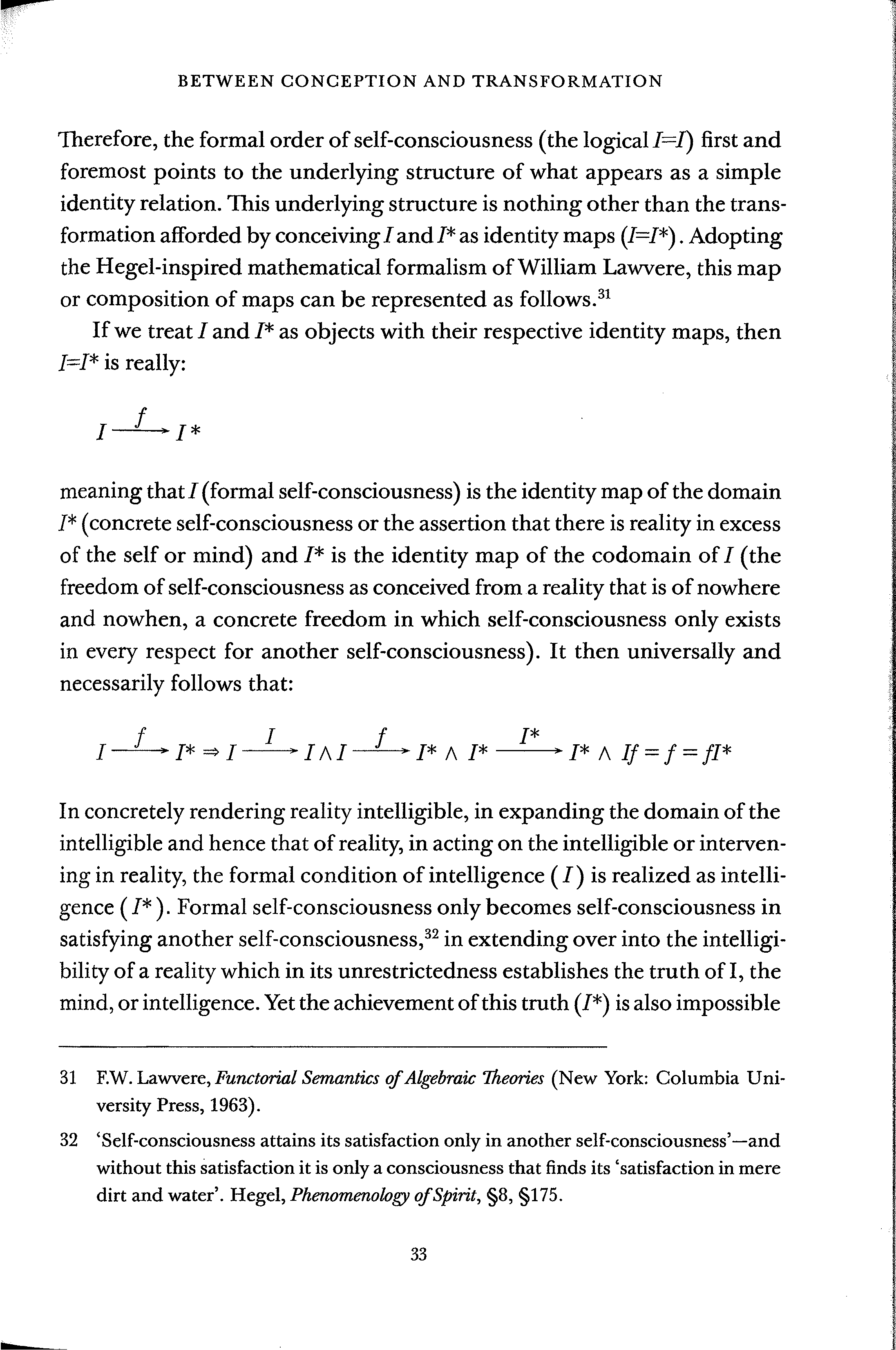
Figure text: I —f—> I*
meaning that I (formal self-consciousness) is the identity map of the domain I* (concrete self-consciousness or the assertion that there is reality in excess of the self or mind) and I* is the identity map of the codomain of I (the freedom of self-consciousness as conceived from a reality that is of nowhere and nowhen, a concrete freedom in which self-consciousness only exists in every respect for another self-consciousness). It then universally and necessarily follows that:
[Figure: A diagram showing the composition of mappings between I and I]*
Figure text: I —f—> I* ⇒ I —I—> I ∧ I —f—> I* ∧ I* —I*—> I* ∧ If = f = fI*
In concretely rendering reality intelligible, in expanding the domain of the intelligible and hence that of reality, in acting on the intelligible or intervening in reality, the formal condition of intelligence (I) is realized as intelligence (I*). Formal self-consciousness only becomes self-consciousness in satisfying another self-consciousness,29 in extending over into the intelligibility of a reality which in its unrestrictedness establishes the truth of I, the mind, or intelligence. Yet the achievement of this truth (I*) is also impossible
without the positing of a truth-candidate that is formal qua rational self-relatedness. But what exactly does ‘self-related’ mean in this context? It is geist as the Concept. Geist’s formal self-relatedness means that it has a concept of itself and that, as such, it treats itself as both the malleable subject and object of its concept. Rather than settling for the given immediacy of what it is, mind becomes mind only by virtue of what it takes itself to be. This ‘what’ is nothing but mind’s concept of itself, whose content and nature are susceptible to change. And in so far as the concept belongs to the negativity of reason, not only can it negate the apparent immediacy of what mind is (the given), it can also positively extend over into the world.
It is necessary to point out that the rational order of self-relatedness, even in its minimal form (I=I), is already an I=I*. In other words, general I-thoughts are not thoughts of a single individual (the monadic I), but belong to an order in which one self-conscious individual always stands in relation to another self-conscious individual. The order of formal self-consciousness already assumes a collection of individuals who stand in relation to one another through a formal space which is, at bottom, a deprivatized semantic space or language—the dasein of geist. I am only I, I am only a minded creature conscious of itself, in so far as I am part of this thoroughly public semantic space, to the extent that I am recognized by a minding act of another I through this space. I only have private thoughts to the extent that these thoughts are modelled on a public language. I am only conscious of myself as minded and minding because I am being recognized by another minded and minding I.
This recognitive system, which is built on an interactive semantic space, simply is the order of self-consciousness. Personhood is the product of the impersonality of reason, and consciousness of the individuated self is an artefact of an individuating recognitive space in which all selves are incorporated. In short, there is no consciousness without self-consciousness. Correspondingly, there are no cerebral particular Is without mind as a collective geist. But if the formal sociality of mind is a necessary condition for achieving concrete self-consciousness, it is by
no means a sufficient one.30 Real self-consciousness is a historically and socially mediated process that makes this formal truth a concrete one. The first stage of this process consists in the recognition and augmentation of formal self-consciousness—or reason—whose linguistic and logical space is the infrastructure of cognition.
SELF-CONSCIOUSNESS AS CONCEPTION AND TRANSFORMATION IN AN OBJECTIVE WORLD
Logical self-relatedness defines the principal function of general intelligence as that which recognizes and acts on the objective intelligibility of the conditions of its realization. Exhibiting the formal order of self-relation, intelligence does not regard itself as the given of its history. It does not treat itself as a monad closed in on itself (a trivial identity relation). Instead, it treats its history as that which negates what is given in its immediacy and, as such, is ‘only appearance and accidentality’.31 The fragile project of freedom, or the move toward concrete self-consciousness, starts as soon as geist gives up the given immediacy of itself to itself—the given truth of what it is—and instead brings itself under a concept of itself—what it takes or conceives itself to be.
Unlike the given immediacy of that which is in itself, what geist takes itself to be in accordance with the order of reason opens up a window of opportunity for grasping what it is in itself in reality. But precisely to the extent that what geist takes itself to be might radically differ from what it really is (as in the case of a historical delusion), it is always in danger of relapsing into the givenness or accidental immediacy of its own truth.
Therefore, the self-conception of geist—its treating itself as the object of its own Concept—is not just a potential window into freedom but can also be a manhole leading to great tragedies and grand delusions. In facing these two possible consequences, geist cannot recoil in fear—it must choose. For without taking the path opened up by self-conception, it ceases to be geist. It is only a windowless monad, ‘a negative reflected into itself’ that ‘repels itself from itself’.32
Within this immured world, nothing can ever be said or done, since everything has already been said and done, nothing is ever complex since everything is absolutely simple, and nothing is ever risked for everything is already given. Take the uphill path of freedom and risk its fragility and your livelihood in descending into the abyss of the intelligible, or take the downhill path of an easy fall back to the homely earth where nothing is ever risked (despite bravado to the contrary). But intelligence is only as a denizen of an intelligible abyss. In its current manifestation it may have come from this earth or another, but from the perspective of the abyss of the intelligible, it has no grounded home and never will have. A third alternative to the battle of the uphill path and the downhill breeze does not exist, for it is the unintelligible as such.
As a function of the geist that is always underway, formal self-relation is both a source of enablement and disablement. Only if geist refers to itself through the intelligible (ontological, epistemological and axiological intelligibilities, i.e., impersonal values and disvalues) is its self-relatedness an enabling condition. However, if self-relatedness is ever posited as a given or deemed to be a completed totality, it becomes the source of self-deceptions and tribulations. The former path is that of tedious tasks but also risky adventures one after another; the latter is the exemplification of residing in a comforting home whose foundations, sooner or later, will be eroded. In its positive form, self-relation enables intelligence to treat its own structure as the intelligible object of its own understanding, thus occasioning an estrangement or alienation whereby the thinking self, or more precisely the understanding (Verstand) self, is as much subject as it is object.
Self-relation as the formal condition of self-consciousness, then, begins with a disunified self for which the self is at once I and not-I (i.e., another self). Yet this disunified, alienated, or ‘epistemically schizophrenic’ self is, properly understood, not a crippling moment for self-consciousness, but rather the condition of its enablement as a task.33 For as soon as the self becomes the object of its own understanding, it opens up the opportunity to grasp itself through the conceptually mediated presence of other selves and, by extension, as an object in connection with other objects within an intelligible reality. Self-consciousness can concretely expand in so far as the relation of the self to itself is now susceptible to change in the presence of other subjects.
This by no means suggests an abandonment of the subject in favour of objects or an alien reality, but rather a grasping of self-consciousness in terms of the search for intelligibilities or ‘the exploration of conditions for object-intentionality’.34 If self-consciousness is only self-conscious in the presence of other selves, and if the shift toward objects does not entail the annulment of self-consciousness but merely a shift in the level of self-consciousness, then the ultimate phase of self-consciousness should be seen—by way of speculative reason—as the self-consciousness of the Absolute. And it is in its attainment of the Absolute—a self-consciousness that has found and secured its own intelligibility in that of an unrestricted universe—that the task of self-consciousness can be understood as the critique and progressive suspension of all local and accidental features of transcendental subjectivity, and thus as a movement further and further away from simple forms of consciousness and self-consciousness. In this sense, the maturation of self-consciousness, the idea of reinventing the subject through the exploration of conditions for object-intentionality, should be understood as a thoroughgoing process of naturalization.
But in contrast to the dominant myopic naturalistic trends, a genuine programme of naturalization is not just about explaining self-consciousness in terms of a material reality, but equally about giving an account
of nature that accommodates a full-blown transcendental philosophy, the formal distinction between thinking and being, and the absolute formal autonomy of reason: that which facilitates the process of unifying consciousness in knowledge of the sensible object (gegenstand) and self-consciousness in knowledge of the self qua object of thought (objekt). Such a program of naturalization, accordingly, cannot and should not be limited to the terms of the empirical sciences. As much as it should afford the fully fledged naturalization carried out by the empirical sciences, it should also allow for nonempirical claims regarding the autonomy of reason and the maturation of self-consciousness as such. Naturalization is, therefore, a universal method not exclusive to the empirical sciences. It corresponds to an adequate concept of nature in which both homo homini lupus (human as wolf)35 and the distinct formal category homo sapience (human as reason), human as the product of ‘infinite natural conditionality’36 (pure heteronomy) and human as the ‘individual of history’37 (the autonomous object of its own Concept) are possible and thus can be actualized or made true. If naturalization only alludes to one of these possibilities to the exclusion of the others, then the concept of nature upon which it is erected is in fact impoverished.
This is to say that this framework of naturalization can no more fall back on a pretranscendental conception of the mind than on a prescientific one, since this entails a precritical account of nature in which either the structuring mind is supplanted by a prestructured nature, or the formal spontaneity of thought and the objective world are merely fused together rather than being integrated in a manner that preserves their distinction. On this account, those who push for a brute disenchantment—a supposed all-destroying demystification of Forms or Ideas—will be condemned to face a fully enchanted and mystified world.
However, to say that, in the transformation of self-consciousness, it is the conditions of object-intentionality that undergo change, rather than
the principle of subjectivity (i.e., the self as an object rather than the self as a subject), is not to suggest that the transcendental subject remains in every respect intact. In other words, it is not to suggest that upholding the necessity of transcendental subjectivity all the way commits us to the necessity of every feature or structural aspect of the transcendental subject of experience. Indeed, if the transformation of self-consciousness into more expansive modes implies that the subject’s relation to the self has been fundamentally changed by its relation to the world (i.e., naturalized in the above sense), this also means that the transcendental conditions of experience, and correspondingly the subject’s transcendental structures, which set the limits of experience, must undergo transformation.
The movement of self-consciousness from its simple egocentric form in which it is disjointed from itself to a self-consciousness in which such a form can be suspended in favour of a unity that is truly essential to it, cannot be achieved by rudimentary or abstract self-consciousness itself. All the egocentric form of self-consciousness can achieve is to further entrench itself by objectifying or unilaterally negating what is other to it—including itself as the object of self-consciousness. What is necessary in order to suspend this purely egocentric form is a renewed relationship between the transcendental subject and the world in its full objectivity, one that allows for a conception of reality which, in its radical and impersonal otherness, actively negates back. To recapitulate, the suspension of egocentric self-consciousness requires another self-consciousness or, more comprehensively, an objective and impersonal reality that is not merely at the receiving end of negation. However, the renewal or expansion of the relation with objective reality that this demands requires an expansion of the transcendental subject’s field of experience, whether as regards other subjects (intersubjectivity) or as regards the world (objectivity). Absent the latter, the act of suspending (aufheben) cannot be continued concretely since either the conception of the world as radically other becomes a negatively abstract speculative thought verging on unintelligibility, in which case the egocentric framework can reestablish itself, this time under the guise of an alien other or material reality; or the subject is confined to a transcendental horizon unchallenged by new objective facts of experience, in which case
the implicitly egocentric characteristics of the subject’s experience not only go unchecked but are also liable to be mistaken for the characteristics of objective reality.
Here, however, a problem arises: Since the limits of experience are set by the subject’s particular transcendental structures, the scope for expansion of the field of experience is ultimately restricted to the limitations of those structures.38 Thus the concrete movement of self-consciousness, the suspension of the purely egocentric framework, and the objective grasp of mind as a unifying point, can only begin with a critical reflection on the possibility of the variation and modification of transcendental structures. The outcome of this necessary critique would be a concrete transformation of the local transcendental subject. To be forthright about it: there can be no concrete movement of self-consciousness, no prospect of a renewed and expanded relationship with other subjects or with the world in its objectivity, without a methodical and multifaceted transformation of the structure of the transcendental subject itself.
As will be argued in chapter 2, it is in this sense that something like the program of artificial general intelligence, adequately understood, is at its core a deeply philosophical project aiming to renegotiate the limits of experience and self-consciousness by carrying out a systematic and applied critique of human transcendental structures, whether pertaining to neurobiological sensory mechanisms, memory and perception, or language and linguistic faculties. Contemplating the possibility of artificial general intelligence—a thinking subject with a physical substrate that is not biological, or one that is capable of using an artificial language that in every respect surpasses the syntactic and semantic richness of natural languages—is to be regarded neither as technoscientific hysteria nor as intellectual hubris; it is an expression of our arrival at a new phase of critical self-consciousness.
For geist, critical self-conception and self-transformation in the objective world is an undertaking whose prospects are by no means guaranteed by the realization of the transcendental subject, or discursive apperceptive intelligence. There is in fact a gap between the conditions of possibility of the I that thinks and the conditions sufficient for the real movement of thought. However, this gap can indeed be bridged by critical reflection on the conditions of possibility of the thinking self as a minded and minding subject. But this hinges on the key idea that critical reflection, in this case, cannot be limited to the function of understanding or transcendental reflection in which the analysis and comparison of concepts or representations (e.g., mind and world, subject and object, etc.) are conducted in relation to their respective sources in cognition. This is because transcendental reflection operates within the limits set by transcendental structures which both undermine the objective identification of the source of concepts/representation in cognition and limit the knowledge of cognition in general. Transcendental reflection on the conditions of possibility of having mind must be supplemented with critique not merely as an analysis but as a practical construction, and reflection not merely as a function of understanding but as speculation in its Hegelian sense, i.e., the movement toward that which is objective and the suspension of that which is immediately given or present.
Accordingly, critical reflection on the conditions of possibility of having mind entails both understanding what these conditions are prima facie, and the construction (i.e., revision or modification) of such conditions by suspending the immediate appearance of them as allegedly necessary and universal. This is in fact an underlying claim throughout the book: that the concept of mind is not something that is immediately present to us or something of which we have already a full grasp. If we limit our critical reflection on mind or the thinking subject to transcendental reflection, we risk misconstruing those accidental and local characteristics of the mind that are immediately present to us as essentially necessary and universal. It is only when reflection suspends what is immediately presented as necessary and universal—but might as a matter of fact be purely accidental and local—and treats necessity or universality as something to be determined
and constructed rather than something that is simply given, that it can become genuinely critical.
Therefore, mind as both the subject and the object of critical reflection is in reality the conception of mind as a project of determination and construction, rather than mind as a given or completed object of ordinary reflection. Critical reflection on the conditions of possibility of having mind should then essentially be understood not in terms of what the mind is, but rather in terms of what the mind does—that is to say, in terms of the concept of mind as that which can construct, modify, and shape itself in accordance with what it takes to be its essential function. To adopt a Hegelian viewpoint: It is only mind that can construct itself according to its concept and, in doing so, develop itself from what is merely a concept into a concrete reality—a development which is equivalent to the knowledge of mind beyond immediate appearances. The Concept (Begriff) of mind is akin to a seed out of which the Idea (Idee) of mind as a project of concrete self-knowledge and self-transformation can grow. It should be noted that the difference between the Concept of mind and the Idea of mind is a subtle one. The Idea is a fully realized or actualized Concept; in a sense, it is the truth of the Concept as realized in particulars (individual subjects) rather than as abstracted from them. The Idea of mind is neither purely the Concept of mind nor mind as viewed from the perspective of objective reality (whether construed as being, material reality, or nature), but the integration or bridging of Concept and objectivity. What is objective signifies the mutual determination not only of each subject by every other subject (intersubjectivity) but also of the subjective realm and objective reality (Realität), which is the detailed knowledge of that plurality in which the Concept is expressed.
Accordingly, the Idea of mind can be said to be the construction or development of the concept of mind as a blueprint within intelligible objective reality. Moreover, the Idea of mind is concerned with the integration of the epistemological, ontological, logical, empirical, and practical aspects of mind into one single set of concepts.
Consciousness is meaningless without a sensible object (gegenstand). It must have an object in order for it to count as consciousness, even if
that object is itself. Concrete self-consciousness, by contrast, is realized when consciousness becomes the object (objekt) of its own concept. In the latter sense, the object is an artefact of the concept—that is to say, a constructible object of determinate thought. The process of determining the meaning or truth of mind is nothing but the process of coordination of mind as an object of its own concept with mind as the critical subject of conception. The Idea of mind captures exactly this process of coordination through which mind is constructed as the object of more adequate concepts of itself—more adequate in the sense that such concepts of mind exhibit higher orders of unity between the identity of the concept and objective reality.
To argue that we do not know what mind is, and that therefore all talk of mind or mindedness is baseless—or worse, that it comes down to an attempt to determine the meaning of mind purely in terms of a set of empirical facts about it—is to confuse knowledge of mind qua gegenstand which remains bound to the existing conditions of experience with knowledge of mind qua objekt constructed according to its own concept. Knowledge of mind is not knowledge of an object that is (allegedly) immediately given by the senses or the conditions of experience; it is a knowledge that is under construction, in accordance with the logical function of mind within an objective world (i.e., mind as a configuring or structuring factor).
As the seed or blueprint for the Idea of mind, the Concept of mind contains both the logical function of mind as a configuring or structuring factor in the world, and a set of objective or empirical facts regarding its properties in so far as it belongs to that world. It is neither a logical idea abstracted from its physical properties nor a set of empirical descriptions independent of its logical function. As a truth-candidate for the idea of mind rather than the truth of mind as such, the Concept of mind, then, initially at least, is nothing but the realized concept of the human mind, a mixture of what we take to be its logical function and its physical properties as they appear to us. Thus the examination of the necessary conditions for the realization of mind begins with the conditions of possibility of this rudimentary Concept of mind, for which the distinction between body and
mind is neither adequately formulated or grasped. For this reason, the main emphasis in subsequent chapters will be on the conditions necessary for the realization of the Concept of mind as an embodied logical function that concerns the structuration of the world.
A SERIES OF TRANSFORMATIONS
The first contact of intelligence with the objective intelligible world is its encounter with its own underlying structure. By rendering intelligible this structure, geistig intelligence enables itself to intervene in its own structure and, in doing so, not only to transform itself but also to achieve a conception of itself that is not limited to what appears to be immediately present or a given totality. Thus it can be said that adequate self-conception leads to the enabling of self-transformation, and concrete self-transformation opens the path to objective self-conception.
Consequently, self-relation does not punctuate the structure of intelligence with an immutable identity, it transforms it. Just like the act of pointing to a point, an act that at once articulates what the point is and transforms it from something fixed into a dynamic gesture, the formal self-relation both articulates the intelligibility of the self-conscious mind and defuses its given fixed identity.39 This is the logic of self-relation as a
dynamic process wherein the identity of both ‘what refers’ and ‘what is referred to’, ‘what acts’ and ‘what is acted upon’, is defined by the unity of their transformations. Here, identity is the unity of a group of transformations that reveal its invariant features by ranging across its variations. This is by no means a weak interpretation of identity, but rather a strict notion of identity that entails neither fixity nor simple relationality.40 There is no incompatibility between having a precise or strict notion of identity and a notion of identity through change and transformations.41 If geist has an identity, this does not imply that its identity must be an entity or thing. It is the activity of geist that defines its identity, through a series of transformations which are its historical instantiations under its concept.
Geist’s self-referential activity is a constructive process in the same way that the act of pointing or referring should be regarded not as a relation but strictly as a transformation. The role of formal self-relation is to establish the intelligibility of geist as that which is able to constitute its own transformation or to have a history rather than just a nature. But the articulation of this intelligibility is in reality equal to the transformation of geist, and vice versa. By pointing to itself as a unifying point or a configuring factor, geist acts on itself; and by acting on itself, it navigates the space of its concept. It changes its configuration. By pointing to its concept, by navigating the space of this concept further away from appearances or what seems locally to be the case, geist can explore the possibilities of its realization. The history of geist, which is the history of intelligence, is a sequence of self-transformations according to its own concept, a concept whose particular content is open to revision. This sequence or history, as will be argued in chapter 4, must necessarily be thought as an atemporal series of transformations. As we shall see, in its genuine form it is a history conceived according to a view from nowhen.
In becoming conscious of itself beyond the given identity relation, geist must first render intelligible its own underlying structure, its conditions of realization. For it is only by acting on the objective intelligibility of these conditions that geist can reconstitute or realize itself according to its own concept. Geist’s formal self-referential act, therefore, does not imply an immediate relation, a path that is limited to what is given or a privileged access to what seems to be immediate. In fact, as will be elaborated later, in order to maintain its intelligibility, geist must adapt to and act on a new order of intelligibility beyond the level of appearances and the given: the order of intelligibility concerning the nonmanifest as excavated by the modern sciences. Self-reference or self-recognition through this order of intelligibility engenders a different form of transformation, and signals a new phase for geist.
HISTORY AS THE ELABORATION OF WHAT IT MEANS TO BE AN ARTEFACT OF THE CONCEPT
Spirit is in itself the movement which is cognition—the transformation of that former in-itself into for-itself, of substance into subject, of the object of consciousness into the object of self-consciousness, i.e., into an object that is just as much sublated, that is, into the concept. This transformation is the circle returning back into itself, which presupposes its beginning and reaches its beginning only at the end. Insofar as spirit therefore is within itself necessarily this act of distinguishing, its intuited whole faces up against its simple self-consciousness, and since that whole is what is distinguished, it is thus distinguished into its intuited pure concept, into time, and into the content, that is, into the in-itself.42
The ongoing labour of science in deepening the order of intelligibilities pertaining to the mind-independent, the nonmanifest, the nongiven, introduces a qualitative shift in the structure of intelligence. Science
(Wissenschaft) ranges across not just the empirical sciences and the science of mind, but also embraces the science of history and the science of the Greater Logic, which is the science of thinking the intelligible unity of mind and world, thought and being, the autonomy of the former and the excess of the latter’s otherness.
In order to uncover and act on the order of intelligibilities and to unbind its transformational capacities, the structure of intelligence itself must also undergo transformation. Science, that which excavates the order of intelligibilities, is responsible for the qualitative transformations in the structure of geist, its history. What is meant by conceiving here is ‘bringing into conception’, since the goal of spirit, according to Hegel, is to concretely attain its own concept, to form a normative conception of itself and to realize itself according to this conception rather than a given nature or meaning:
The spirit produces its concept out of itself, objectivizes it, and thus becomes the being of its own concept; it becomes conscious of itself in the objective world so that it may attain its salvation: for as soon as the objective world conforms to its internal requirements, it has realized its freedom. When it has determined its own end in this way, its progress takes on a more definite character in that it no longer consists of a mere increase in quantity. It may also be added that, even on the evidence of our own ordinary consciousness, we must acknowledge that the consciousness must undergo various stages of development before it becomes aware of its own essential nature.43
The intelligibility of geist resides in its freedom, a freedom that is not simply freedom from constraints but a freedom to do something. It is a freedom that translates into intelligence. It stands for the ability of geist to constitute a history for itself rather than just a past or nature. But the ability to constitute history can only be realized by the ability to
posit a concept of itself and to then transform itself in accordance with that concept. This is what the formal order of self-consciousness already implies. Mind entails a self-relatedness which is not a given and simple identity-relation, it is what it does in order to be a unifying point for the intelligibility of itself and its unrestricted world. The concept of mind as a unifying point, accordingly, extends over the order of intelligibilities (of itself and reality).
But what does this extension over the order of intelligibilities mean for the concept of mind? It means that any particular or given content of this concept will be suspended, with only its form remaining necessary and invariant. The revision of the content of the concept of geist—its particular identity, its contingent configuration—is what the history of geist is. This is exactly what the concept of progress implies. In thinking about geistig progress, one has to suspend the ordinary intuition of a temporal progression, a march from the past to the future. Instead the concept of progress should be understood primarily in terms of a cognitive process—the step-by-step dissolution of all givens and achieved totalities of thought, in order to distinguish between what is particular and contingent for mind and what is necessary and universal for it—that can become socially concrete and explicit. Progress, in this sense, is neither linear nor essentially temporal. Freedom and intelligence thus coincide in the question of what it means to have a history and to sufficiently elaborate its consequences. The ramifications of having a history, the prospects of what it means to become an object of a concept and to be transformed by it, belong to the domain of intelligence—that which is always underway, neither given nor realized in its totality.
Hegel is the archenemy of the given, in that he takes the battle against the given from the realm of thought to that of action. Geistig intelligence does not merely abolish the givens of theory but also the givens of praxis and history. In defining the progress of geist as the elaboration of what it means to be the artefact of a concept whose content can and should be revised, Hegel gives the concept of progress paramount significance in the fight against the given. Geist must go beyond the given and develop its own concept, but only so as to further elaborate the meaning of this move
against the given in action by transforming itself according to a concept that negates all particular, manifest, and given contents.
Kant’s transcendental turn was a major assault on the given. Before Kant, the sensory world—sensory data—was taken to be the locus of structure and categorial forms, while mind was a block of wax or a blank slate readily admitting these givens. With Kant’s transcendental turn, the situation was reversed. The data became the blank slate and mind became the structuring or configuring point. But Hegel took Kant’s assault on data one step further by arguing that, in so far as mind is an object of its structuring concept and in so far as it has a history, it must also in practice remove the givens—that is, the supposed completed totalities—of its history. Hegel’s transcendental turn is therefore not just about the formal autonomy of thought, but its concrete objective historical freedom. How this relates to what Wilfred Sellars calls the ‘myth of the given’ will be discussed in subsequent chapters, in various guises.44
Geist’s history is a dynamic between its positive and negative conceptions. Only by acknowledging itself as simultaneously a positive and negative configuring factor, both that which provides freedom and that which hinders it, can spirit overcome itself and exercise the freedom of self-realization. If it is to expand its capacity to modify itself so as to maximize its functional autonomy, intelligence must treat the conditions required for its realization—be they natural or normative—as both negative and positive constraints: negative in so far as they must be overcome in order to increase autonomy over the conditions of realization, and positive in so far as this autonomy cannot be increased unless these conditions qua conditions of enablement are identified and harnessed to effect transformation. It is within this twofold approach to the conditions of realization that the attitude of intelligence to its natural history is revealed. In order for intelligence to become an artefact of its own concept and to progress or transform itself qualitatively according to this concept, it must regard its natural conditions of realization as impediments to be overcome. But in order to overcome
them, it must identify its natural constraints so as to modify or replace them with alternative realizers more in accord with its concept of itself.
Even though intelligence has a natural history, short of reorienting, repurposing, and reengineering this natural history, it ceases to be intelligent. The augmentation of intelligence or the enablement of geist remains a highly implausible dream if it does not scrutinize its natural history, differentiating its positive and negative constraints. But an intelligence that does not develop its own normative conception as to how it ought to be—a move that inevitably culminates in reengineering and revising its natural constitution, its multiple realization—is even more implausible. Reconstituting our nature demands that we do not forget our natural history or conditions of embodiment, since ‘how we ought to be’ cannot disregard the structural-material constraints of realization. But ‘not forgetting our natural history’ does not entail foregoing the reconstitution of our nature, unless we subscribe to a regime of final causes in nature according to which the causes of how things are and the reasons for how things ought to be are seamlessly sutured. Furthermore, natural constraints are only one set of constraints among others (social, linguistic, economic, etc.).
Intelligence commandeers its given nature by way of the history of its own obligations and demands, for the history of intelligence only begins in earnest with the cumulative reworkings of its given constitution, progressively breaking away from the given in all its manifestations. When it comes to geist, it is more apt to speak in the plural, to speak of histories or chronicles of reconstitutions rather than of a history of constitution. For intelligence, reconstitution is adaptation to new regimes of designed purposes or ends that are themselves open to reassessment and revision. In fact, the fallibility of such ends impels the self-correcting attitude of intelligence. Mind’s realization amounts to the modification of its conditions of realization. This is what the function of functionalism of mind implies. Once mind is realized as a configuring factor, the path to a complete functional analysis of the mind is unavoidable; and this path leads to the complete reorganization of mind, its systematic artificialization.
Artificiality is the reality of mind. Mind has never had and will never have a given nature. It becomes mind by positing itself as the artefact of
its own concept. By realizing itself as the artefact of its own concept, it becomes able to transform itself according to its own necessary concept by first identifying, and then replacing or modifying, its conditions of realization, disabling and enabling constraints. Mind is the craft of applying itself to itself. The history of mind is therefore quite starkly the history of artificialization. Anyone and anything caught up in this history is predisposed to thoroughgoing reconstitution. Every ineffable will be theoretically disenchanted and every sacred will be practically desanctified.
A NOTE ON THEORY, MIND’S STRUCTURING FUNCTION, AND RATIOCINATING POWERS
Since the term ‘theory’ is often loosely employed, to the point where ‘theoretical’ has become a vague if not vacuous qualifier, it is necessary to provide a minimal criterion for what is meant here by theory or theoreticity as intrinsically associated with the concept and the idea of mind, and more importantly the ineliminable correlation between intelligence and the intelligible. A theoretical framework is a triple $\langle L,S,U \rangle$, where:
$L$ is language for theory, i.e., language with explicit formal dimensions and semantic richness and transparency.
$S$ is structure as associated with the mind as the factor of conceptualization or structuration. Structure is a well-differentiated and ordered $n$-ary relation $R(\langle R.lexicals, R.names, R.ends, R.entities, R.aspects, R.processes, R.domains \rangle)$ and operations $O(\langle O.lexicals, O.names, O.ends, O.entities, O.aspects, O.processes, O.domains \rangle)$ between multifaceted aspects, elements, or parts of an entity, domain or process such that:
$R.lexicals$ assigns a set of lexicals $l$ to each relation. Lexicals denote properties of relations or entities and can be seen as another tuple $\langle l, l.names, l.type \rangle$ where, for example, $l.type$ assigns a type to each lexical.
$R.entities$ assigns a set of entities to each relation.
R.ends assigns ends (i.e., a target entity, aspect, etc.) to each relation.
Etc.
The n-ary relational-operational framework (how distinct entities, aspects, processes, etc. hang together in the widest sense) then would also require generalization hierarchies over entities, aspects, processes, and domains. For example, the generalization of a set of processes P can be denoted as P.gen ⊆ P×P. This would allow us to talk about taxonomic relations between two or more processes. If processes p₁ and p₂ are child processes then they inherit the lexicals, and the connections between associated processes, etc. of their parent processes.
With the introduction of structure, we no longer talk about things in the world, but only structures (of the mind) or objective facts about the world.45
- U is a universe of discourse or the dimension of comprehensive data provided for the purpose of conceptualization or explanation. For example, integers or biological species can be posited as universes of discourse.46
Theory becomes absolutely systematic when L is taken to be language and logoi, namely, logic and mathematics. In addition to the traditional Platonic logoi—as they will be introduced in the next chapter—we should also include computation, specifically in the manner defined by today’s theoretical computer science as distinct from (but in fundamental correspondence with)
logic and mathematics, and as the generative framework of language in its syntactic and semantic breadth. In this sense, computation is what removes the hard distinction between language and logoi. Yet for the construction of an absolutely systematic theory, the most important modification is to take $U$ to be the unrestricted universe of discourse wherein one can frame theoretical claims (It is the case that...) with no a priori limit on the scope of such a universe. In contrast to a restricted universe of discourse (e.g., integers or even all numbers), the unrestricted universe of discourse is characterized by the absolute openness of its scope with regard to its accommodation of the data provided by language and logoi and its permitting of the elaboration of all interdependencies, connections, and distinctions between various thematic components—hence the possibility of systematization.
It is crucial not to mistake what we call data for sense data or sensory givens. The concept of data under consideration in this book is strictly associated with mind’s structuring function, and will be elaborated in the following chapters under two fundamental classes of data: the axiomatic class (or the formal givens) and the truth-candidacy class, which generates a different kind of structure than that of the axiomatic. As we shall see in the final chapter, the absolutely systematic theory of intelligence, or the programmatic conception of philosophy whose central concern is the craft of the ultimate form of intelligence, works primarily with data as truth-candidates, and only secondarily in the context of specialized domains with axiomatic data.
Following Puntel, the triple can be abbreviated as $\langle S,U \rangle$,47 such that $S$ is bought up by the combination of all possible syntactic and semantic structuring abilities of the mind. Defining theory as a tuple means that the elements should be considered in terms of the totality of their relations. The well-orderedness of the tuple implies that all the three elements $L$, $S$, and $U$ fit together. For this reason, any systematic theory should make explicit how such elements hang together within it. This articulation should be regarded as an essential aspect of the presentation of the theory itself.
rather than as a matter of metatheoretical consideration or reflection on the presented theory.
Since the explicitation of the relations between structure and the universe of discourse is in reality the articulation of the connections between the logical function of the mind as a structuring factor and the data under consideration provided by the logoi or the mind’s ratiocinating powers, in elaborating how its S and U fit together, any genuinely systematic theory should also elaborate in what manner it is an extension of a philosophy of mind. By philosophy of mind, I specifically refer to how the question of mind is framed within German Idealism, where it refers to the concrete movement between the concept of mind as the combination of an existing physical embodiment and a necessary logical function, and the idea of mind as the full realization of such a concept and its corresponding object. In so far as without the logoi there is no intelligibility,48 without the intelligible the question of framing intelligence is an empty thought. By elaborating theory in this way, we can drop the metaphysically slippery copula of mind and world, and instead talk about theory and object, which belongs to a family of formal fundamental dualities (not dualisms) such as structure and being (Puntel), being and nonbeing (Plato), or sapience and sentience (Brandom).
SELVES AS FUNCTIONAL ITEMS AS ARTEFACTS OF MIND
The movement or progress of geist represents the construction of complex rational agents through normatively (rather than naturally) evolving forms of self-consciousness. The community of rational agents may draw upon a model of self-consciousness in order to exercise its freedom by first developing a self-conception and then transforming itself in accordance with it. In building upon its conception and instituting its transformative practices, geist qua community of rational agents can then construct superior models of self-consciousness, and can thereby structure different
kinds of self-conscious selves. But this movement, as argued earlier, depends upon how willing, competent, and systematic geist is in uncovering the order of intelligibilities pertaining to itself and the unrestricted world that is coextensive with it. We might say that the movement of Spirit projects competing models of self and their corresponding modes of awareness.
Earlier we saw that the necessary link between conception and transformation is the key to the freedom of Spirit—‘producing its concept out of itself and becoming the being of its own concept’—that is to say, constituting a history for itself rather than a nature. The selves that make up the configuration of geist are essentially rational selves, selves only realized by the formal order of self-consciousness or reason. They are to geist only functional items. Geist’s superior modes of integration or cognitive unities are built out of these functional items and their logical roles (for example, the ways in which these selves are collectively organized, how the discursive context of their activities can be enriched, how their cognitive significance can be socially elaborated, and so on). What constitutes apperceptive selves as the functional constituents of geist is the formal social configuration of geist itself—formal in that it is a rule-governed discursive space or public language. Like an artificial multi-agent system, geist is the configuration—the configuring and the configured—of discursive apperceptive rational or thinking selves. However, this system is structured not by simple communication or social grouping but by a logical or inferential-semantic space. Endowed with qualitative global activities, the multi-agent system is what constitutes and is constituted by various types of interactions between its local components or, in this case, the activities of the thinking self—theoretical and practical cognitions. While geist synthesizes the unity of apperception, it is the integration of apperceiving selves in their recognition of one another that positively modifies the qualitative activities of geist which, in turn, condition more enabled cognitive-practical selves. This framework should be seen firstly as the formal systematicity of recognition—something which, as we shall see, can be couched in purely logical, linguistic, and computational terms. Next it can be viewed as a concrete social project of collective recognition which is the object of theoretical and practical—in the broadest sense of
what theory and practice can be—labour and interventions. Even though the formal social systematicity of mind is not a sufficient means for fulfilling the latter, without an adequate grasp and mobilization of the formal sociality of mind, any concrete endeavour will fail. Within both the formal and concrete social dimensions of mind, no one has ever a mind of their own. Mind is cognitive only in that it is recognitive all the way down—computationally, logically, linguistically, and socially.
To mistake mind for the brain is not only to collapse the formal (i.e., nonsubstantive) distinction between thinking and being, but also to fall into the trap of an incoherent cerebralism for which the mind becomes the given cerebrum of the individual agent. The social manifestation of the demotion of mind to an individual where one can always point to a given cerebrum is what Hegel calls individual, or more precisely individualistic, stubbornness, a consciousness ‘bogged down’ by its own ‘servility’:
Because not each and every one of the ways in which his natural consciousness was brought to fruition was shaken to the core, he is still attached in himself to determinate being. His having a mind of his own is then merely stubbornness, a freedom that remains bogged down within the bounds of servility. To the servile consciousness, pure form can as little become the essence as can the pure form when it is taken as extending itself beyond the individual be a universal culturally formative activity, an absolute concept. Rather, the form is a skill which, while it has dominance over some things, has dominance over neither the universal power nor the entire objective essence.49
THE SAPIENCE CONTROVERSY
Humans are functional items of mind. And by human we mean a rational self, a discursive apperceptive intelligence, or a sapient creature. Promoting humans as the constituents of mind always risks triggering bad memories of socioculturally charged human exceptionalism, the legacy of conservative
humanism. But the controversies around human sapience all originate in one way or another from the illicit merger of sapience understood as a formal quality which can encompass any sentience that structurally satisfies its condition of realization, and sapience understood as a substantive quality that ranks a being above other beings. Whereas the former conception of sapience can be adequately understood as a functional diagram or minimal yet revisable description of the capacities necessary for thinking and action, the latter is a concrete account of the human as described by a set of contingent characteristics and abilities. Sapience is not a being; it is a necessary and positively constrained form or Idea in the Hegelian sense of this term. Necessary since, without this form, the recognition of the world and by extension sentient beings or more generally the dimension of intelligibility, is impossible. And positively constrained in so far as its realization rests upon necessary conditions or enabling constraints which are both causal and logical. Sapience is a formal criterion—a sui generis form—and therefore should not be treated as a substantive essence or being. Accordingly, to treat sapience as a species or rank in the order of being is to elide the difference between that which is formal and that which is substantive, thinking and being, reasons and causes. Sapient awareness—which is of the order of self-consciousness or reason—is not sentient consciousness. It is a necessary form for bringing about qualitative change in the structure of sentience by becoming the site of special kinds of logico-computational activities, judgements, inferences, and conceptualizations. Sapience, therefore, marks the ingression of logico-conceptual functions as a new class of broadly regulative functions into sentient activities. In a nutshell, the human as a form only indicates the deep correspondence between intelligence and the intelligible, structure and being: the fact that intelligence without intelligibility in the broadest sense is merely an ideological fixation, and that there is no way to speak of intelligence without the labour of intelligibility. To sidestep the labour of intelligibility in favour of intelligence or nonhuman intelligent behaviours is a sure formula for confounding what is intelligent objectively and what is intelligent subjectively. That is to say, conservative humanism and the anthropomorphization of the universe creep in the moment we dismiss the
form or the idea of the human—or sapience as a set of positive/enabling constraints for thinking and action—as a token for the labour of intelligibility.
As suggested by Peter Wolfendale’s phrase ‘the reformatting of homo sapiens’,50 sapience is a qualitative change in the class and types of activities of sentience brought about by a qualitatively distinct class of activities. Any sentience that comes under these activities or functional form will be essentially regulated and reformatted.
Rather than representing a new rank in the order of beings, sapient awareness articulates a constructive principle or a form that discontinues the supremacy of humans as a biological species. It dissolves and assimilates the manifest configuration of the human species—and of any other sentience that falls under it—into the new unities of the impersonal mind. By reformatting sentient consciousness with logico-conceptual functions, sapient awareness weakens the governing role of its material substrate—be it biological or social. It progressively liberates its conditions of realization from its natural constitution. By synthesizing a framework in which it is possible to be at once responsible for thinking something (a judgment) and responsible for doing something (an action), it increases its cognitive, theoretical, and practical freedoms. By rationally evolving into a self capable of treating itself as an artefact—approaching itself as the artefact of its own Concept—it puts forward a concept of sapient agency amenable to the possibility of realization in other artefacts. Far from being an achieved totality, human sapience is what breaks its attachment with any special status or given meaning. It is an artefact that belongs to the history of mind as the history of artificialization. The cognitive exploration of ‘what it means to be human’ or ‘what sapience consists in’ takes shape as a systematic exercise in developing the object of an evolving Concept. Succinctly speaking, sapient awareness is a cognitive-practical project through which the realization of the human is rigorously subjected to changes in the content of the concept of the human. Yet in so far as the structure of this concept is formally constituted, and since it describes the human not by recourse to substantive
essences but in terms of necessary structuring abilities which can be brought about by different sets of material realizers, it expands the prospects of the realization of sapience, extending it to the realm of artefacts as pure objects of craft and artificialization processes. However, in no way does this mean turning artefacts into a repository for the conservation and reproduction of the canonical portrait of the human that belongs to the realm of biology and sociocultural particularism. Sapient awareness is a constructive principle for the production of a self endowed with content-awareness; neither the essentialist identity of this self nor the boundary and the quality of the content-awareness according to which it conceives and transforms itself are fixed. Sapience is a constructible activity, not a structurally fixed entity. From the perspective of this constructibility, the assertion that the sapient is an animal qua sentient is an exercise in prejudiced dogmatism: it places a limit on the possible realizations of the sapient form by limiting it to a particular physical or biological organization.
It is a matter of fact that the currently embodied human is both sapient and sentient, both an artefact of the concept and a biologically embodied animal. But what makes the human human qua sapience is formal and not substantive. This autonomous rule-governed form is not a dimension of the human qua sentient or natural species. The distinction between the sapience of the human (reason) and the sentience of the human (Homo sapiens sapiens) is ultimately the formal distinction between thinking and being. It is the dividing line between formal distinction and substantive indistinction. It follows that not only the current homo sapiens but also any sentience can be a sapient so long as it satisfies the minimum necessary conditions of the formal autonomy of thinking in which our own sentience is caught up. We shall examine these necessary conditions in the following chapters. As humans we look at our animality and say: I see in you the abyss of intelligence, but in me you see nothing. Only to the extent that we are sapients are we critically aware of ourselves as sentient among other sentients, as integrated bundles of rational and nonrational processes. The difference between sapience and sentience is not an essential feature of biological species, nor should it be narrowed down to homo sapiens or the common-sense picture of humans. Of course, one can always object that thinking
is ubiquitous in nature and that ultimately sapience is in fact sentience. For now, Lorenz Puntel’s response should suffice to dispel this confusion:
Discussions motivated by the question whether animals (or specific kinds of animals) ‘think’ (or have minds, etc.) usually have nonsensical aspects. Without a criterion for thinking, it is nonsensical to ask whether or not a given kind of animal thinks. Here, such a criterion is available: the type of ‘world’ that corresponds to the ontological constitution of a given kind of being. If this ‘world (Welt)’ is a pure (hence restricted) environment (Umwelt)—only an Umwelt, hence not, unrestrictedly, the Welt—then there is no ‘intelligence’ in what this book accepts as the genuine sense, because this sense is defined as requiring that the ‘worlds’ of beings that think be unrestricted (as is the case for human beings). Of course, if one associates a different concept with the term ‘thinking,’ then some kinds of non-human animals may well ‘think.’ But then the question is reduced to a purely terminological one.51
Everything that Puntel says about thinking can be repeated word for word in reference to mind. The thinking of sapience is defined in terms of its conceived world, in that the world of sapience has no restriction whatsoever on what can be asked or thought. The thinking of sapience is coextensive with everything.
To be human is the only way out of being human. An alternative exit—either by unbinding sentience from sapience or by circumventing sapience in favour of a direct engagement with the technological artefact—cannot go beyond the human. Rather it leads to a culture of cognitive pettiness and self-deception that is daily fodder for the most parochial and utilitarian political systems that exist on the planet. In delivering sentience from its so-called sapient yoke, one does not become posthuman, or even animal, but falls back on an ideologically charged ‘biological chauvinism’52 that
sapience ought to overcome, for it is the very idea of humanist conservatism that misrepresents what is accidental and locally contingent as what is necessary and universal. In discarding the human in the hope of an immediate contact with superintelligence or a self-realization of the technological artefact, one either surreptitiously subjects the future to the predetermined goals of conservative humanism, or subscribes to a future that is simply the teleological actualization of final causes and thus a resurrection of the well-worn Aristotelian fusion of reasons and causes. Human sapience is the only project of exit.
We cannot bypass the labour of overcoming the quandaries of humanity by positing a dubious metaphysical alternative to the human as a shortcut to freedom. In doing that, we would simply dissolve the problem rather than solving it. In reality, antihumanist alternatives to the idea of the human ironically end up endorsing the most conservative anthropomorphic traits under the guise of some dogmatic figure of alterity. Inasmuch as such antihumanist alternatives have already foregone the geistig resources necessary to diagnose and suspend the conservative traits or characteristics of the human, they become the servants of that very conservative concept of the human they originally set out to escape.
We as manifest humans must come to terms—psychologically, cognitively, and ethically—with the hard fact of what it means to be human: One cannot have the cake of humanity without eating its consequences. Once we treat ourselves as a species of rights and entitlements, once we say what ought or ought not to be thought or done, the moment we distinguish the order of things and respond to it in accordance with what we think is right, however far from truth it may be, we have committed ourselves to the impersonal order of reason to which sapience belongs—an order that will expunge our manifest self-portrait.53 We have crossed the cognitive Rubicon. In committing to this impersonal order we must realize that what is manifestly human—us as we stand here, now—will be overcome by that very order. Reason is a game in which we are all fleeting players and from
which we cannot defect, so let us play this game well by committing to its interests and its ramifications. As transitory embodiments of sapience, we can only recognize our mixed animality and the fact that what makes us special is the capacity for such recognition—for recognizing that, as sentients, we are absolutely not exceptional—and take the implications of being sapient to their furthest conclusions. Through the growth and maturation of reason, the definition and significance of the human is freed from any purported substantive essence or fixed nature. The formal appellation of ‘humanity’ becomes a transferable entitlement, a right that can be granted or acquired regardless of any attachment to a specific natural or artificial structure, heritage, or proclivity, since being human is not merely a right that is simply obtained naturally at birth through biological ancestry or inheritance. The title ‘human’ can be transferred to anything that can graduate into the domain of judgments, anything that satisfies the criteria of minded and minding agency, be it an animal or a machine. The entwinement of the project of human emancipation—both in the sense of the negative freedom from the limitations established in advance or created by ourselves and the positive freedom to do something or become something else—with the artificial prospects of human intelligence is the logical consequence of the human as a transferable right.
RATIONAL INTEGRATION, JUDGEMENT,
AND GENERATION OF FURTHER ABILITIES
The kind of self that is required for establishing the necessary link between geist’s conception and transformation is defined functionally by its roles in assuming rational responsibility (judging): using its rational unity to treat one set of commitments as reasons for or against other commitments. This is a thinking self, or a discursive apperceptive intelligence: an intelligence that is conscious of its own experiences through the rational unity of self-consciousness, and whose experiences are structured by concepts of mind. Unlike god or other imaginary intelligences, this intelligence has no direct contact with reality other than through its own geistig configuration.
Since thinking selves are a functional item that represents a qualitative set of activities (judgements or reasons), their formal (semantic-pragmatic) and concrete sociality can effect qualitative changes in the structure of geist or in the activities by which these selves identify themselves, individually and collectively. In other words, in its every dimension the collective configuration of thinking selves or rational agents—synchronically in time or diachronically across time—determines the course of the concrete project of self-consciousness. Mind has a configuration—sequences of self-conceptions and self-transformations—which is extended in time. Geistig activities, therefore, are not merely recognitive-cognitive but also recollective-reconstructive. Thinking selves are then not just the locus of judgements afforded by the recognitive dimensions of rational responsibility and authority—that is to say, the capacity to make oneself liable to distinctive kinds of (conceptual) normative appraisals. In addition, they are the locus of recollective-reconstructive judgement—the ability to extend recognitive acknowledgement to the recollections of history. What we are referring to here is geist’s ability to be conscious of and to judge its constituted history as represented by the responsibilities and authorities of past judges. Rational selves, then, are also defined by their content-awareness of those activities, judgments, decisions, conflicts, values, and variables that have constituted their history and have led to their current configuration.
In order to have this content-aware experience (erfahrung) of history and to gain epistemic traction on it, geist must be able to represent to itself a reconstruction of its past transformations and their specific realizers (those activities and constraints which have brought those transformations about). Accordingly, the recollective reconstruction of the past history of conceptions and transformations should be understood as an essential feature of the self-related logic of mind whereby the mind not only recognizes its different structural transformations across time as its own unified experience, but also uses this experience to generate new abilities, to correct or rewrite its values and disvalues, and to construct itself differently. For intelligence, then, History is an order of intelligibility and thus a condition of its enablement. Any configuration of Is or thinking selves (any we) is simply a part of this history, not its totality.
What we were is now suspended in what we are, and what will be is suspended in the history of intelligence. To intelligence we are merely a historical intelligibility that enables but does not impede it.
Once the rational self as the basic functional item of geist is constructed, geist is able to conceive a historical concept of itself—a historical unity—and to act on it. This historical unity or integration requires, on one level, the recognitive-cognitive principle of ‘the synthesis of an original unity of apperception through rational integration with a model of the synthesis of normative-status-bearing apperceiving selves and their communities by reciprocal recognition’. 54 On another level it entails a recollective-reconstructive principle of ‘synthesiz[ing] a rational (including consequences and excluding incompatibles) contemporary unity by integrating the commitments of past judges’. 55 Only when rational selves concretely incorporate these two principles into their own conception of what to think and do, are they able to see the truth of themselves as an ongoing history of intelligence, realizing that their freedom lies in the freedom of mind as a historical artefact of its own concept, a necessary link between self-conception and self-transformation that ought to be rendered sufficient. The concept of history then is nothing but a necessary link—a dynamics—between conception and transformation. The concrete actualization of this history, however, is a matter of a thorough recognitive-cognitive struggle by rational selves.
By constituting its own history, geist acquires the power of self-cultivation, or the capacity to assess and develop its history via superior modes of self-consciousness which then allow geist to form and carry out more refined and comprehensive conceptions and transformations of itself. To put it differently, the elaboration of history as an emancipatory activity is an outcome of constructing and organizing rational selves incorporated within higher geistig unities through which they can concretely transform themselves.
HISTORICAL AWARENESS AS AN ESSENTIAL CONSTRUCTIVE AND CRITICAL ABILITY
By providing themselves with descriptions regarding their past transformations, and by putting these descriptions into a form that can be historically expressed and assessed, rational selves can develop adequate theories and practices for reorganizing or transforming themselves. This process is the sociohistorical equivalent of the rational unity of consciousness. Historical consciousness is a distinct kind of consciousness specific to discursive, concept-using, self-conscious creatures able to apply the principle of rational integration to the history of their transformations, giving cognition an explicitly historical role. The agency of rational selves in effecting such a transformation indicates that they have discarded every given in their history, as well as any god or deus ex machina. Agency in its concrete sense is not merely rational autonomy. It is also the realization that anything that appears as an autonomous self-apprehending thing or process without rational agency—be it theological, natural or technological—is a practical given, a precritical adolescent fantasy, a delusion of stubborn and servile consciousness.
Through developing historical consciousness, geist is able to identify negative and positive trends of the past, abandoning the former and cultivating the latter. Therefore, historical consciousness provides thinking selves with a principle of self-cultivation through the assessment and correction of the sequences of their self-transformation—which is not just their transformation but, in so far as it takes place in the real world, also has positive and negative effects on the world they inhabit. Recollective reconstruction of the tradition—of an earlier sequence of historical transformations—opens up previously endorsed goals, commitments, and conceptions to rational assessment. Goals become objects of understanding and are then susceptible to revision and, where necessary, relinquishment. It is this susceptibility of goals to a kind of revision and assessment whose norms can themselves be discursively reappraised that prevents the intrusion of predetermined goals (whether natural or normative) into the conception of collective general intelligence.
By applying the principle of rational integration to its temporal manifestation in time, geist conducts a cognitive inquiry into the conditions required for both its temporal synthesis and the synthesis of temporality as such. It is a pragmatic component of the project of collective general intelligence to transform itself by renegotiating the links between the temporal categories of past, present, and future. But its critical component consists in reexamining and redefining the nature of temporality—even if that means dispensing with those temporal conceptions and categories to which it has become accustomed. Mind’s consciousness of its history is ultimately the exploration of history as the interface between subjective time and objective time, temporal forms and time’s formlessness.
The history of geist, properly understood, is a recognitive-cognitive technology. It is not only a semantic web through which geist’s manifest realizations (self-conceptions and self-transformations) can become transparent and open to analysis, but also a scientific milieu for the development of cognitive means and practical technologies for subjecting what is a manifest realization—the appearance of a totalized history—to a concrete transformation, scientifically suspending what was previously deemed a completed historical totality in an ongoing process of totalization, namely, history. Geist’s concept of revolution requires a scientific intervention in history so as to transform what appears to be the manifest destiny or the totality of history into history proper, in which all achieved totalities are merely fleeting manifestations.
Here we arrive at Hegel’s idea according to which geist’s self-apprehension as what is in itself (the fleeting reality of its manifest realization) must be subjected to what geist is for itself (what it takes itself to be, its labour of conception). This is because ‘what it conceives itself to be’ is receptive to correction and susceptible to profound changes stemming from the undermining of appearances by new orders of intelligibility which are outcomes of a systematic project of cognitive inquiry or science. Thus what count as conditions required for the realization of geist cannot be limited to the constellation of different particular models of selves, the modes of their organization, and institutions which reflect the manifest realization of geist. These conditions must also involve the development of cognitive
and practical tools for bringing manifest realizations of geist under the rational unity of superior and more adequate modes of consciousness. Only once a manifest totality is understood as an appearance, a fleeting realization, can it be concretely overcome. Here ‘adequate’ means both richer forms of content and context-awareness, and a sensitivity of these modes of consciousness to resources (cognitive, practical and material) and diverse intersubjective relations between subjects that encompass a broad range of economic and other relations.
THE DASEIN OF GEIST
Spirit is supposed to be cognized in its own ‘outer’ as in a being, which is language—the visible invisibility of its essence. [...] Here once again we see language as the existence of spirit. Language is self-consciousness existing for others. It is self-consciousness which as such is immediately on hand, and as this self-consciousness, it is universal.56
Both self-consciousness and historical consciousness require recognitive and recollective, retrospective and prospective cognitive abilities. But these abilities can only be acquired through language, as a scaffolding for the organization of a community of normative-status-bearing apperceiving selves. This is where the role of language as the dasein of geist and as a generative platform upon which mind takes shape and evolves in time comes to the foreground. In its most basic and necessary form, language is merely discursive speech (an ordinary natural language). In such a natural language the interface between the syntactic and semantic is interaction, or pragmatics as the social use of syntactic-symbolic vocabularies, which progressively affords new levels of semantic complexity or conceptual expressivity. The concepts of language are not merely labels or classifications, but descriptions. There are concepts that do not simply describe, but also allow cognitive simulation via counterfactuals. Semantic complexity in its full richness, then, comprises different grades of concepts, concept-using
abilities, and the various corresponding modes of rational integration afforded by them. Robert Brandom distinguishes the structural levels of semantic complexity of concepts afforded by the pragmatic interface between syntax and semantic as follows:
• concepts that only label and concepts that describe, • ingredient and freestanding conceptual contents, making explicit the distinction between the content of concepts and the force of applying them, and • concepts expressible already by simple predicates and concepts expressible only by complex predicates.57
In its specialized format as the infrastructure of all theoretical structurations of the world, language is essentially formal. The significance of formal languages lies in their capacity for what Catarina Dutilh Novaes terms ‘desemantification and resemantification’.58 This is the ability of formal languages to be detached and abstracted from any particular content (topic-independence) so as to be generally applied to different contexts. The desemantifying ability of formal languages is tantamount to the explicit re-enactment of mind outside of any particular individual experience or contextual meaning—formal languages as the prostheses of extended cognition and epistemic enablement. Decoupled from any particular content, ‘desemantification allows for the deployment of reasoning strategies other than our default strategies, thus enhancing the “mind-altering” effect of reasoning with formalisms’.59 In addition, formal syntactic languages can be explicitly computable. This is the achievement of Noam Chomsky, in putting forward a hierarchy of formal grammar or syntax where the complexity of syntax is articulated in terms of computational complexity. Chomsky’s hierarchy classifies different types of syntax (recursively enumerable, context-sensitive, context-free and regular)
in terms of the combinations of generative processes required to produce them, the formal grammatical properties that specify them, and the automata necessary for computing them.60
Finally, in its ultimate superior mode, language refers to artificial general languages—languages in which the full hierarchy of syntactic complexity (of formal languages) and the full hierarchy of semantic complexity (of natural language), computation and conception, desemantification, resemantification, and semantic enrichment all exist side by side, reinforcing one another. Before proceeding, let us briefly look at the phenomenon of language—although the topic of language and its role in the formation of minding activities (judgements and inferences) will be surveyed in more detail in chapters 6 and 7.
The emphasis on the principal role of language for mind is an old topic. But what has been largely absent in studying the role of language for mind is the deep logico-computational structure of language itself, where language can be seen as much as a multilevel syntactic complexity as a multilevel semantic complexity. This is language neither as a medium of direct access to reality nor as a system of public discourse, but as a framework of interaction-as-computation incorporating different classes of semantic and syntactic complexity and the cognitive-practical abilities associated with them. This interactive computation permits qualitative compression of data and selectivity of compression, it significantly reduces the size of the agent’s internal model while increasing its complexity, and it can format and modulate the agent’s behaviours, stabilizing the multi-agent epistemic dynamic without which it is impossible for any agent to be aware of itself and to experience. Built on this computational interactive dimension, language is above all an engine for the generation of qualitatively distinct cognitive abilities. It is precisely what reshapes intelligent behaviours not by degree but in type (e.g., a linguistic agent differs from a nonlinguistic agent in type, not in degree).
The archetypal figure behind language is computational duality or interaction. Interactions are the prevalent phenomena in language, and they can be concurrent, synchronic, asynchronic, typed or untyped, deterministic or nondeterministic. Interactive systems are online, open, and reactive to multiple streams of input. Interactions are governed by computational dualities. In simple terms, these dualities signify the interchange of roles between two or more processes or behaviours which constrain one another, resulting in the generation of additional constraints or rules which increase the complexity of behaviours involved in interaction. In theoretical computer science, these interactive dualities are called ‘open harnesses’. Open harnesses simultaneously constrain the behaviours of the interacting systems (hence the constraining connotation of ‘harness’), and harness them to a new design (a behaviour with a higher level of complexity). By pitting two systems against one another, they force the systems to correct their behaviours and to augment their capacities, as in a game that harnesses one player to respond intelligently to another, and where the totality of the game is always in excess of its players. But this is not a game in the game-theoretical sense: as topics of logic and theoretical computer science, interaction games are devoid of precise goals, payoff functions, or predetermined winning strategies or procedural rules for how the game should be played. Instead, the rules of the game emerge naturally from the interaction itself. Interactions are a medium of complexification for processes. In the words of Jean-Baptiste Joinet:
As vague as the notion of process may be, it certainly is in their nature not only to evolve (amongst the effects produced by a process appear its own transformations), but also to produce effects on other processes, mutual effects. In short, processes act and interact. Whatever its technological matter, whatever its implementation, the essence of a process is completely involved in its (potential) dynamic behavior: not only its own possible destinies under evaluation, but also the full set of possible operational effects it will occasion in all possible processes’ interaction contexts. With respect to semantics, the answer brought by processes is
thus of a radically new kind, which implements the performative way of meaning: doing, is the way processes speak.61
But unlike generic interactive processes, the logico-computational interactions of language have the ability to increasingly incorporate lower-level interactions within higher-level interactions (i.e., interactions with more semantic complexity or, in Wolfendale’s terms, interactions that reformat lower-level interactions) and to form stable linguistic items with their own specific transformation rules across different levels. It is in the context of a complex network of interaction that rules are obtained and stabilized; some may be context-sensitive, others may be applied across the board. Semantic values or meanings are abstractions of linguistic locutions together with transformation rules for their use, which are both derived and used in their stabilized form through the interaction.
The realization of mind or general intelligence is inconceivable without language not merely as a structuring edifice but also as a necessary and vast computational framework for the generation of higher-order cognitive faculties (theoretical and practical judgements). Just as there is no structure in the world without the structuring mind, there is no mind and no unrestricted world without the structuration of language and its unrestricted universe of discourse wherein everything can be questioned or subjected to systematic theorization. General language (as opposed to this or that language) has no borders or limits. In the same way that we cannot step outside of mind to gain direct access to reality, we cannot step outside of language as the armature of mind. In stepping outside of one language, we only find ourselves in another more general language:
[T]o speak of a limit drawn by language (or by a language) is to be, linguistically, beyond the putative limit. A limit is a limit only if there is something beyond it, so to identify a limit to language is also to enter the linguistic space making it possible to speak of what is beyond the
limit, and thus to negate the identification of the ‘limit’ as a limit of the language that bespeaks it as a limit.62
The phenomenon of language in its full syntactic and semantic complexity cannot be captured outside of the logico-computational linguistic interactions of which pragmatics (meaning as use or discursive meaningfulness) is only the uppermost visible instantiation. Since mind or general intelligence is inconceivable without language, and to the extent that language requires an interactive framework, the idea that mind or general intelligence could be realized in anything but a community of agents is a dubious one. Humans are only minded and minding agents in that they have sociality. In the same vein, the idea of an artificial realization of general intelligence in anything but a multi-agent system rather than a single agent is something of a bygone twentieth-century science fiction. Artificial general intelligence is a product of interactions, be they between nurturing humans and child machines, or between machines that have graduated into the domain of artificial general languages.
To this end, general intelligence should be seen not only as a repertoire of existing cognitive abilities but also as a generative framework for the realization of new cognitive abilities by adjusting to the syntactic-semantic resources of language. It is the linguistically charged competence to proliferate, diversify, and maximize theoretical and practical abilities that sets general intelligence apart from complex causal and pattern-governed processes exhibiting a powerful yet restricted range of behaviours. The intrinsic affinity between general intelligence and language as a socially embedded and constructive medium for the elaboration and realization of the abilities of mind points to the social bases of general intelligence. There is no predetermined limit to the type and range of cognitive technologies that can be garnered by excavating ‘the visible invisible essence’ of geist or language. The possibilities of what can be done with language are as unfathomed as the possibilities of what language can do to its users.
THE NECESSARY AND SUFFICIENT LINKS BETWEEN CONCEPTION AND TRANSFORMATION
Having presented an overview of mind not as an ideal object but as a social project, we can now shift the focus to the ramifications of developing and partaking in such a project.
Hegel’s systematic elaboration of geist in functional terms has both a critical and a constructive import. The functional analysis of the spiritual or geistig struggle—i.e., the struggle of spirit to become the object of its own concept, to refine the content of this concept, and to devise abilities to actualize itself as the object of its concept—reveals how this struggle is realized, and how it can degenerate and precipitate pathologies of consciousness and their social manifestations. This type of analysis sets the stage for an in-depth diagnosis through which it is possible to identify what ought to be changed, and to specify those structural joints or material organizations that ought to be treated as sites of struggle. It is in this sense that Hegel’s deep functional picture of geist as that which has a history and has the ability to treat its history as a milieu of intelligibility in which all achieved totalities are fleeting shadows and appearances lays the groundwork for Marx’s project of communism as the real movement that concretely and determinately negates the present state of affairs, the givens of history. The uncovering of history as a new domain of intelligibilities requiring special kinds of theoretical and practical cognitions brings to light those sites where struggle and intervention must take place in order to achieve a consequential and concrete liberation from the present state of affairs perceived as the totality of history.
The import of the functional picture of geist resides in how this picture highlights key activities and abilities through which the mind as a social project can be augmented and amplified. Primary among these activities are conception and transformation; both are labours of mind, but one places more of an accent on systematic theorization, the other tends toward concrete practice. However, at no time can these two be separated: they are as mutually reinforcing as they are intrinsically linked.
Essential self-consciousness is explicated by the necessary link between self-conception and self-transformation as two distinct yet connected
activities: that of conceiving (i.e., bringing into conception) ourselves in the world, and that of transforming ourselves in accordance with our self-conceptions.63 Each transformation serves in turn as a pivot for a different encounter with ourselves in the world. Alteration in the order of self-conception induces a change in the self of which it is a conception, and a qualitative difference in the self induces a transformation in the general or geistig conception of the self. The positive feedback loop between conception and transformation instigates a disequilibrium, with each difference in one order destabilizing the other and becoming a cue for its readaptation. This disequilibrium is particularly intensified as subsequent conceptions become further removed from the order of appearances, and in the process the latter are determinately negated. The act of self-conception must yield progressively more fine-grained conceptions of the geistig self (what it means to be a minded and minding agent, a human, an embodiment of intelligence); but in order to do so, it must break away from the mere appearances of its present conception, its manifest realization.
In conceiving itself in terms of this process of simultaneous self-recognition and self-negation, the history of geist is no longer entailed by its past states, even if it is constructed out of them. The self-conception of geist via determinate and concrete negation of its conceptual content (how it appears to itself) brings about a real movement of history in which geist’s sequence of self-constituted transformations are not merely the repetitions of its past stages. Within this movement, any totalized state of realization is taken to be a historical appearance with regard to the reality of history qua incomplete and ongoing totalization. The history of geist, in this sense, is neither a linear progression between different states of geist’s realization (epochs) nor a series of isomorphic transformations. The reality of what geist is now is not the reality that it used to be. What geist or intelligence will be is never what it is or has been, where ‘never’ implies the elimination of the one-to-one relationship between the sequences of geist’s transformation. Historical consciousness, or awareness of this fact—what
it means to identify the appearances of history and determinately negate them—is the kernel of concrete self-consciousness as the real movement of emancipation.
The adequacy of self-consciousness is an index of the quality of conception and transformation and an indication of how effectively self-conception and self-transformation are integrated within the order of intelligibilities. Just as a robust self-conception brings about a consequential self-transformation, a flawed or impoverished self-conception incites a defective or inconsequential self-transformation. But in so far as our self-transformation is embedded in the objective world, its flaws are not isolated. Depending on its proportion and persistence, a pathological self-transformation can trigger a disaster by laying ruin to those structures that environ and support us. This calamity also debilitates our capacities to act, either simply by depleting the resources required for perpetuation and transformation, or more insidiously by causing a disorientation that prevents us from decisively thinking and taking measures, detecting and acting on opportunities without the crippling anxiety of further deterioration and imaginary tragedies. Blinded by the oppressive fear of tragedies, the diagnosis of what exactly is wrong (revealing the ‘specific’ inadequacies of conception qua determinate negation) then falls under the jurisdiction of abstract negation and unconscious self-deception. In supposing ourselves to have dispensed with all illusions and escaped all the traps of history, we succumb to naivety and cognitive-practical despondency.
In this environment, reasons which form and adjudicate recognitions, obligations, responsibilities, and pertinencies (what matters and what does not) are discredited by a critical discourse on the irrationality of reasons tout court, and an insistence that we should dispense with them. Reasons are unmasked as social irrational causes that merely disguise the roots of what is oppressive and exploitative. This critical discourse then becomes an exposé on how causes not only semantically distort reasons but also masquerade as reasons. Reason is burnt at the stake, accused of being the ultimate trap of history, the supreme collaborator with the oppressor, a smokescreen for the conditions of exploitation. Once freed from the tyranny of reason, critical discourse presents itself as an egalitarian exposition of
the causes of oppression and exploitation. Having immolated the trap of all traps—reason—critique is now fully disillusioned and emancipated. But to dispense with the conceptual and normative resources of reason in order to expose their causal irrationality, and to diagnose oppressive pathologies via the reasonless appraisal of causes, amounts to the impoverishment of the semantic requirements necessary for the intelligibility of any diagnosis. In other words, the unconscious undermining of the criteria required for the adequate consciousness of the self occasions a consciousness which is inadequate to have a proper conception of itself in the world and to determinately transform itself in accordance with such a conception. The reasonless critique or diagnosis of what is oppressive and exploitative becomes the prognostic course of the disease or pathology itself. In being an inadequate consciousness, the critique unconsciously justifies those pathologies of history it is bent on eradicating.64
Founded on the intelligibility of the concept and the intelligibility of practices, the adequate self-consciousness is distinguished as a multitasking project comprised of four basic undertakings:
(1) To evaluate and correct our self-conceptions (using the resources of both common-sense rationality and those of the sciences, with the understanding that they yield two different images of ourselves in the world that should be integrated).
(2) To coordinate our self-transformations with better self-conceptions (i.e., self-conceptions informed by a broader order of intelligibilities).
(3) To amplify the influence of our rational and scientifically informed self-conceptions over our self-transformations (the shift from a necessary link between the two to one of sufficiency).
(4) To revise and where necessary abandon our self-conceptions in accordance with the intelligibility of how and into what we are transformed.
Formulating self-consciousness as a project rather than as an ideal object allows us to conceive of the vocations of thought and action not on an ontological basis, where the ideal abstractness of thought is contrasted with the ideal concreteness of action, but on a methodological basis, where thought must first make a concrete difference in itself in order to make a difference in the world. The interplay between the abstract and the concrete is then conceived methodologically as the determination of concrete abstraction and the abstraction of the concrete—a dialectics through which making a difference in thought and making a difference in the world can be bidirectionally mediated by autonomous transformative actions in the order of thought and in the order of the world. Autonomy in reference to transformative actions describes the ability of these actions to repurpose or reorient themselves in accordance with self-contained rational ends. It is important to note that to speak of functional self-containment in this sense does not imply the denial of the existence of material constraints. In fact, it simultaneously brings about the opportunity to uncover such constraints and to examine how they can be modified.
To every abstract moment of science, there corresponds a shape of appearing spirit per se. Just as existing spirit is not richer than science, so too spirit in its content is no poorer.65
The reinforcing link between self-conception and self-transformation characterises essentially self-conscious creatures or rational agents as those possessing the capacity to constitute a history and to have a contentful experience of it, to have impersonal norms regarding what ought or ought not to be done in order to maintain and expand the intelligibility of their history.
This capacity unfolds the truth of intelligence as a social cognitive-practical enterprise in the order of intelligibilities, of things, practices and values. In reality, the systematic encounter with the order of intelligibilities is the inexorable consequence of the realization of geist by the specific qualitative set of activities that distinguish it.
The formulation of self-consciousness as a matter of practical achievement underlines the import of self-conception as a recipe for action without which action cannot maintain its practical intelligibility. Conception without praxis is unrealized abstraction and praxis without conception is a hollow impression of concreteness. Self-conception in its concrete form is a search for intelligibilities pertaining to the world of which we are part. Self-transformation in its consequential form is the intelligibility of practices in response to the intelligibility of what the world we inhabit is, together with what we ought to be in accordance with the ends of thought. The recognition of ourselves, the conceiving of ourselves within one or multiple self-narratives, is by definition the construction of ourselves within the order of intelligibilities. There could be no ‘us’ without our encountering ourselves and bringing this encounter into a conception not only of who or what we are, but also of where we have come from, where we are, which paths have led to where we are, and which paths we ought to take. The conception of this encounter is thus an open landscape of inquiry into different orders of intelligibilities. The conceptual awareness of one’s experience of the world is a necessary framework within which one can know oneself in the world, and how to change oneself and the world.
However, the divergence between what we take ourselves to be and what we actually are, the disparity between the intelligibility of the self and the world as what they appear to be and the intelligibility of the world in itself as what conditions all appearances generates a tension in self-conception and, correspondingly, in the space of self-consciousness as a project. The full recognition of this tension—its simultaneous sharpening and resolution—characterizes the task of scientific rationality or, more generally, the enterprise of science. Again, what is meant by science here is not just the modern empirical sciences, but also the science of history, the science of thinking, or what Hegel dubs the Greater Logic,
and finally the science of impersonal values and disvalues, the science of ethics. While maintaining this broad idea of science, I would however like to discuss the implications of the modern empirical sciences for the project of conception and transformation outlined above. For the field of empirical sciences poses a significant challenge to what is already a challenging project.
The core protocol of modern empirical science consists in striving for explanation. Why do we see what appears—in our ordinary common-sense experience—to be the case, and yet know that it is not the whole of reality? Science overturns the order of what appears to be subjectively the case by providing its objective explanans. It differentiates what was previously an apparent explanation into an explanandum the explanans of which remains to be found. The explanatory force of science reaches its peak when it overturns the universe that seemed to be ontologically dependent on the mind into a universe that is independent of mind. Yet in overturning what is simply subjectively manifest—the universe hypostatized as the reificatory dependent object of mind—science draws on the core components of subjective or minding activities: linguistic doings, conceptualization, and systematic theorization among others. Objective science without subject-constituting mind is a subjective delusion. The movement of scientific inquiry only underlines the necessity of mind in its pure and necessary form. Science, in this sense, is the hallmark of a mind that has matured to learn that it should hypostatize neither its structuring activities nor its structured object, neither itself nor its unrestricted universe. This is a mind whose intelligibility is not immediately given in itself, but is achievable only in its integration—rather than complete fusion or reduction—with an intelligible order pertaining to a non-manifest and mind-independent reality. The enterprise of science is permanently caught up within this integral framework which is comprised of the vocabularies of mind and the items of the world, and whose internal tensions enrich and drive it. But this tension through which science expands itself is exactly the tension exclusive and constitutive to mind, albeit more self-conscious and intensified.
Spirit knowing itself in that way as spirit is science. Science is its actuality, and science is the realm it builds for itself in its own proper element.66
With the advent of scientific explanation and the excavation of an intelligible universe which, in its objectivity, constrains our thoughts about it, the order of self-consciousness—the duality of the intelligible and intelligence—enters a new phase. Matter-of-factual truths pertaining to a nonmanifest and mind-independent universe intrude upon and are ingrained in the logico-conceptual infrastructure of intelligence. As the scientific will-to-explain or the pursuit of explanatory coherence highlights the insufficiency of common-sense concepts, conception begins to adapt itself to science and its unrestricted universe.
Even though the conceptual framework of common sense through which we articulate the intelligibility of ourselves in the world is built upon basic matter-of-factual truths, it does not grant us access to these truths as such; properly conceived, since they lie beyond what manifestly appears to be the case, these truths belong to the framework of scientific inquiry. By assuming otherwise we subscribe to the ideological fixation of the epistemic given—of access to the intelligibility of the world through the supposedly spontaneous intelligibility of our seemings.
Scientific explanation, accordingly, can be understood as an activity of mind that forces the activity of self-conception to renegotiate its original alliance with appearances—particularly the appearance of how the world that appears for mind is in itself. As the order of intelligibilities uncovered by science encroaches upon the intelligibility of that which is manifest, self-consciousness gains a new mobility. The sharp asymmetry between what is manifest and what is scientific, how things appear to be from an ordinary common-sense perspective and how things are as matter of fact, destabilizes the oppressive serenity of the order of mind and things. Cognitive progress can only be maintained and expanded by sharpening this asymmetry, by further amplifying the instability in how mind and the world stand in relation to one another. As the site of this tension, science
advances through positing the transcendental excess of a structuring mind and by positing a structured reality that is in excess of mind.67
Yet the advancement of science need not be understood as a series approaching convergence, or a uniform progression.68 A completed science, or the full and adequate scientific image (of human being in the world) is a regulative ideal. But, as Kant reminds us, when regulative ideals are applied constitutively they lead to contradictions.69 Outside of their regulative use, regulative ideas are pseudo-rational and illusory existences. The account of science as a convergent and uniform progression is not necessary for the certification of science as a vector of cognitive progress. Indeed, this convergent progressive interpretation can result in both irrationality and relativism, both epistemic dogmatism and epistemic anarchy. Wolfgang Stegmüller has provided an incisive critique of this generalized progressivist interpretation of scientific theories.70 Here I will merely summarize his particularly meticulous and technical argument.
The idea of a general convergent progress of science is based on the analysis of the structure and dynamics of scientific theories (the theory-ladenness of all sciences). According to Stegmüller, the conviction of a convergent and uniform progress of science rests on the idea of the general reducibility of one theory (a dislodging theory) to another preceding (dislodged) theory covering the same class of observations. For example, if we can in every respect reduce or map statistical thermodynamics to the
thermal theory of thermodynamics, then we can say there is a uniform or convergent progress from the latter to the former, from the less explanatory to the more explanatory theory. In the traditional study of scientific theories, analysis is performed at the micrological level, pertaining to the stable core of theories. These stable cores are comprised of atomic axiomatic formal sentences or classes of sentences together with their inferential relations. At the level of micrological analysis, to see whether one theory is reducible to another theory a mapping must be obtained from the stable core of the succeeding theory ($T_2$) to that of the preceding theory ($T_1$). But this mapping is precisely based on the reduction of individual theories to their so-called stable cores, a reduction that loses much necessary information regarding the specificity of its content, including ‘the distinction between theoretical and nontheoretical functions, the general and special constraints, and the special laws holding only for certain intended applications’. 71 Accordingly, at the level of micrological analysis—pertaining to the stable cores or sentences and their inferential relations—the reducibility of $T_2$ to $T_1$ cannot be obtained in a nonarbitrary manner. In so far as micrological reducibility presupposes the prior reduction of each theory to its stable core, we cannot generalize the relationship between $T_2$ and $T_1$ in terms of their being generally more inductively simple and generally less inductively simple, generally more explanatory and generally less explanatory, answering more well-formed questions and answering less well-formed questions. The comparison of theory-contents is completely context-dependent. What appears to be less explanatory in $T_2$ may be less explanatory in one particular context than $T_1$. Equally, $T_1$ may answer some well-formed questions that cannot be answered in $T_2$, as in the case of Newton’s and Einstein’s theories of gravitation.
Just because $T_1$ precedes $T_2$ and both cover the same class of observations, it cannot be inferred that the relation between them is that of theory-reducibility in the sense mentioned above. It is only when we move from the level of micrological analysis to the level of macrological analysis, from the stable cores to the model-theoretic view of theories pertaining to their
expanded cores, that we can speak of reducibility. The expanded core of each theory covers the class of partial possible models (i.e., the physical systems about which the theory is talking) or the class of sets of possible applications. Further, the components of the expanded core (its range of possible applications) are unstable and dynamically changing. To secure reducibility at this level of analysis, one has to take a static snapshot of theories at time t in order to obtain the mapping between one theory and another. But this static theory-comparison is itself problematic, since it freezes the dynamic picture of the theory structures and narrows the range of their possible applicability or coverage over possible models.
At the level of the micrological analysis of stable cores concerning formally constructed and inferentially related sentences or classes of sentences, the reducibility fails to be nonarbitrary or general. And at the level of the macrological analysis of expanded cores, reducibility can only be obtained by taking a static view of the dynamic structure of compared theories, hence losing information regarding the dynamic aspects of the theory structures themselves. Stegmüller’s final conclusion is that we do not need a convergent progressivist account of scientific theories to talk about the rationality of science or to avoid relativism. Scientific progress can be seen in terms of the dynamics of each theory structure in itself—the increase in the range of its applicability and achievements as it incorporates aspects of an older theory structure which is now operating under new constraints and laws, and over a larger field of experience. Both the dislodged theory and the dislodging theory may prove successful in certain situations, identification of which requires a rich dynamic picture of their structures.
The true revolutionary import of science lies in its capacity to amplify reason’s own power of knowing and to instigate cognitive expansion. The convergent progressivist interpretation of scientific theories is often assumed to be a preventive measure against irrationality and relativism with regard to scientific theories; but in reality it is an oversimplification that causes more unnecessary problems which can become the source of irrationality. The rationality of science lies not in the uniform progression of science, but in how these theories are constructed and how they expand the capacities of reason and its cognitive traction on the world. In light
of the dynamics of scientific structuration or theoreticity, the rationality of science can be preserved without a convergent progressivist reading of scientific change. Similarly, epistemological anarchism can be shown to be merely a parasitic outcome of the pseudo-rationality of an uncritically progressivist view of science.
Coming back to the role of science for mind, intelligence, and agency, science’s capacity to make the world intelligible beyond appearances as a reality that is in excess of mind represents mind’s movement of self-consciousness as it differentiates its universal and necessary features from its particular and contingent characteristics. The ongoing instability or perturbation caused by the sharp asymmetry between the manifest and scientific frameworks should be seen as a positive condition for self-conception and the corresponding self-transformation, since it results in the increasing refinement of the manifest picture of the agency, its minimalization to a set of logically-irreducible and necessary activities. Science is not an attack upon the logic or essence of the human that should be staved off; it is that which differentiates the necessary aspects of the latter from their contingent features. Pruning the manifest picture of the human and cutting it down to its logico-conceptual, necessary activities and functions is a required step toward understanding the meaning of the human. It is precisely through this minimalization of the manifest that the rational self can be extricated from the neurobiologically fabricated ‘phenomenal self-model’,72 and instead presented as a constructive principle that can be transferred and artificially implemented. It is the continuous labour of science in deepening the order of intelligibility that provides geist with the necessary resources for the determinate negation and reappraisal of the content of self-conception.
In the wake of scientific rationality, mind turns into a wave of noetic deracination. This deracination of thought and its noetic drift is commensurate with what Plato calls the Form of Good as the Form of Forms, since it sets up the scaffolding for a conception of the realm of intelligibilities as
a complex system of recipes for crafting a world which includes not only satisfying lives but also the perpetual demand for the better. The ingredient of these recipes are not just theoretical intelligibilities, the products of modern sciences, but also practical intelligibilities and axiological intelligibilities, the objects of sciences of skill, practice, and ethics, all of which are subsets of the logical functions of mind. This is ethics as the science of impersonal values and disvalues concerning the intelligible unity of freedom of mind and the constraints of the world, the autonomy of thinking and reality in its otherness. But what kind of life would really satisfy the mind, ‘other than one that involves a self-knowledge which has passed through all the stages of disciplined reflection on the source of things’,73 that is to say, their intelligibility? And what is intelligence other than that which knows what to do with the intelligible, whether pertaining to itself or to the world?
Notes
Footnotes
-
‘The history of spirit is its own deed; for spirit is only what it does, and its deed is to make itself—in this case as spirit—the object of its own consciousness, and to comprehend itself in its interpretation of itself to itself.’ G.W.F. Hegel, Elements of the Philosophy of Right, tr. H. Nisbet (Cambridge: Cambridge University Press, 1991), 372. ↩
-
L.B. Puntel, Structure and Being: A Theoretical Framework for a Systematic Philosophy (University Park, PA: Pennsylvania State University Press, 2008), 275. ↩
-
G.W.F. Hegel, Outlines of the Philosophy of Right, tr. T.M. Knox (Oxford: Oxford University Press, 2008), 15. ↩
-
J. F. Rosenberg, Accessing Kant (Oxford: Oxford University Press, 2005), 2. ↩
-
Geistig: of the Mind or Spirit, spiritual. I have deliberately chosen to use the word geistig rather than spiritual so as to avoid any mystical, supernatural, transcendent, or theological connotation (no doubt to the dismay of Hegel). ↩
-
For more details on the logic of suspension as positive dialectic, see U. Petersen, Diagonal Method and Dialectical Logic (3 vols. Osnabrück: Der Andere Verlag, 2002), vol. 2. ↩
-
R. Brassier, ‘Dialectics Between Suspicion and Trust’, Stasis 4:2 (2017), 98–113. ↩
-
‘This path can accordingly be regarded as the path of doubt, or, more properly, as the path of despair, for what transpires on that path is not what is usually understood as doubt, namely, as an undermining of this or that alleged truth which is then followed by the disappearance of the doubt, and which in turn then returns to the former truth in such a way that what is at stake is taken to be exactly what it was in the first place. Rather, the path is the conscious insight into the untruth of phenomenal knowledge, for which the most real is in truth merely the unrealized concept. For that reason, this self-consummating skepticism is also not the kind of skepticism with which a fervent zeal for truth and science imagines it has equipped itself so that it might be over and done with the matter.’ G.W.F. Hegel, Phenomenology of Spirit, tr. T. Pinkard (Cambridge: Cambridge University Press, 2018), 52 (§78). ↩
-
Describing functions using the vocabularies of activities and domain-specificity has ↩
-
See R. Batterman, The Tyranny of Scales (2011), http://philsci-archive.pitt.edu/8678/1/Bridging.pdf; for a more technical survey of the problem of scales and hierarchy in relation to complexity, see R. Badii and A. Politi, Complexity: Hierarchical Structures and Scaling in Physics (Cambridge: Cambridge University Press, 1999). ↩
-
‘The difficulties in the way of a thoroughgoing cerebralism are logical: they rest ↩
-
Plato, ‘Phaedrus’, in Complete Works (Indianapolis: Hackett, 1997), 542. ↩
-
H. Putnam, Philosophical Papers (2 vols. Cambridge: Cambridge University Press, 1975), vol. 2, 302. ↩
-
Interestingly, panpsychism can be described as an implicitly functionalist account of mind, but one with a triviality condition, where the flat picture of function licenses the ubiquity of mind or its unconstrained realization across an expansive continuum. ↩
-
See for example, R. Lucas, ‘Feeding the Infant’, in M. Artiach and A. Iles (eds), What is to be Done Under Real Subsumption (London: Mute, forthcoming). ↩
-
G.W.F. Hegel, The Science of Logic, tr. G. Di Giovanni (Cambridge: Cambridge University Press, 2010), 29. ↩
-
Ibid., 533. ↩
-
‘Appearance, that is, the play of forces, already exhibits infinity itself, but infinity first freely emerges as explanation. When infinity is finally an object for consciousness, and consciousness is aware of it as what it is, then consciousness is self-consciousness.’ Hegel, Phenomenology of Spirit, §163. ↩
-
Ibid., §164. ↩
-
Ibid., §167. ↩
-
See S. Rödl, Self-Consciousness (Cambridge, MA: Harvard University Press, 2007), 52. ↩
-
Puntel, Structure and Being, 275. ↩
-
‘For, in the first place, the monad is a determinate representation of its only implicit totality; as a certain degree of development and positedness of its representation of the world, it is determinate; but since it is a self-enclosed totality, it is also indifferent to this determinateness and is, therefore, not its own determinateness but a determinateness posited through another object. In second place, it is an immediate in general, for it is supposed to be just a mirroring; its self-reference is ↩
-
R.B. Pippin, Hegel on Self-Consciousness: Desire and Death in the Phenomenology of Spirit (Princeton, NJ: Princeton University Press, 2011), 15. ↩
-
Hegel, Phenomenology of Spirit, §204. ↩
-
H.S. Harris, Hegel’s Ladder II: The Odyssey of Spirit (Indianapolis: Hackett, 1997). ↩
-
‘But surely it is laughable to label the nature of this self-consciousness, namely that the “I” thinks itself, that the “I” cannot be thought without the “I” thinking it, an awkwardness and, as if it were a fallacy, a circle. The awkwardness, the circle, is in fact the relation by which the eternal nature of self-consciousness and of the concept is revealed in immediate, empirical self-consciousness—is revealed because self-consciousness is precisely the existent and therefore empirically perceivable pure concept; because it is the absolute self-reference that, as parting judgment, makes itself into an intended object and consists in simply making itself thereby into a circle. This is an awkwardness that a stone does not have. When it is a matter of thinking or judging, the stone does not stand in its own way; it is dispensed from the burden of making use of itself for the task; something else outside it must shoulder that effort.’ Hegel, Science of Logic, 691 (emphasis mine). ↩
-
F.W. Lawvere, Functorial Semantics of Algebraic Theories (New York: Columbia University Press, 1963). ↩
-
‘Self-consciousness attains its satisfaction only in another self-consciousness’—and without this satisfaction it is only a consciousness that finds its ‘satisfaction in mere dirt and water’. Hegel, Phenomenology of Spirit, §8, §175. ↩
-
‘The self-relation in relation to objects and others must be achieved, is a practical phenomenon inseparable from a relation with and initially an unavoidable struggle with, others. Genuinely human mindedness, the soul, spirit, the variety of designations for the distinctly human, are all going to be read through the prism of this idea that such a distinction is fundamentally a result, what will eventually emerge as a historical achievement.’ Pippin, Hegel on Self-Consciousness, 86. ↩
-
Hegel, Science of Logic, 521. ↩
-
Ibid., 474, 486. ↩
-
Pippin, Hegel on Self-Consciousness, 48. ↩
-
Ibid., 47. ↩
-
T. Hobbes, On the Citizen (Cambridge: Cambridge University Press, 1998), 3. ↩
-
H. Cohen, Kants Begründung der Ethik (Berlin: Dümmler, 1877), 108. ↩
-
Ibid., 290. ↩
-
On this point see G. Catren, ‘Pleromatica or Elsinore’s Drunkenness’, in S. De Sanctis and A. Longo (eds), Breaking the Spell: Contemporary Realism Under Discussion (Sesto San Giovanni: Mimesis Edizioni, 2015), 63–88. ↩
-
Consider a point as an object. One can either take it as something fixed, or instead conceive it only through acts of pointing. In the latter case, a point is a pointer that points, like an imaginary mark on paper left by the gesture of the finger pointing to it. Once a point is understood as an act and not merely a product, it can be articulated or gesticulated differently. A pointer can be composed with another pointer to make a new point, and so on. When it comes to defining a point, one can speak not only of a pointer but also of a concatenation of pointers or maps of transformation. In the case of self-reference the same principle holds: ‘what is referred to’ is an object of a referring act. And when self-reference is understood as an individuating act, there can be a concatenation of referring acts which have as their object the same reference. One can always swap the identity of the object qua ‘what is referred to’ with an appropriate collection of referring acts or group of transformations. ↩
-
For an elaborate discussion on philosophical, logical, and mathematical conceptions of identity as a group of transformations, see chapters 6 and 7 in A. Rodin, Axiomatic Method and Category Theory (Dordrecht: Springer, 2014), 149–209. ↩
-
Ibid., 149–58. ↩
-
Hegel, Phenomenology of Spirit, §802. ↩
-
G.W.F. Hegel, Lectures on the Philosophy of World History, tr. H.B. Nisbet (Cambridge: Cambridge University Press, 1975), 64. ↩
-
For a succinct and lucid exposition of this myth, see J.R. O’Shea, Wilfrid Sellars: Naturalism with a Normative Turn (Cambridge: Polity Press, 2007), 1. ↩
-
See for example, J. Ladyman and D. Ross, Every Thing Must Go (Oxford: Oxford University Press, 2009). ↩
-
The term ‘universe of discourse’ originates from Augustus De Morgan’s phrase universe of a proposition specifically meaning ‘the whole of some definite category of things which are under discussion’ but not at all ‘the totality of all conceivable objects of any kind whatsoever’. See W. and M. Kneale, The Development of Logic (Oxford: Clarendon Press, 1962), 408. ↩
-
Puntel, Structure and Being, 45. ↩
-
Cf. Plato’s Phaedo: ‘No worse evil can befall a man than to come to hate logoi’, for in that case he will be ‘deprived of the truth and knowledge of reality.’ (90d67). ↩
-
Hegel, Phenomenology of Spirit, §196. ↩
-
P. Wolfendale, ‘The Reformatting of Homo Sapiens’, Angelaki 24.2: Alien Vectors (forthcoming, 2019). ↩
-
Puntel, Structure and Being, 276 (emphasis on final sentence mine). ↩
-
R. Brandom, Reason in Philosophy: Animating Ideas (Cambridge, MA: Harvard University Press, 2009), 148. ↩
-
‘One can certainly wager that man would be erased, like a face drawn in sand at the edge of the sea.’ M. Foucault, The Order of Things (London: Routledge, 2002), 422. ↩
-
See Brandom, Reason in Philosophy, 81. ↩
-
Ibid., 86. ↩
-
Hegel, Phenomenology of Spirit, §323, §652. ↩
-
Brandom, Reason in Philosophy, 199. ↩
-
See C. Dutilh Novaes, Formal Languages in Logic (Cambridge: Cambridge University Press, 2012). ↩
-
Ibid., 219. ↩
-
See N. Chomsky, Aspects of the Theory of Syntax (Cambridge, MA: MIT Press, 1965); and for more details, R. Hausser, Foundations of Computational Linguistics: Human-Computer Communication in Natural Language (Dordrecht: Springer, 1999). ↩
-
J.-B. Joinet, ‘Proofs, Reasoning and the Metamorphosis of Logic’, in L.C. Pereira, E. Haeusler and V. de Paiva, Advances in Natural Deduction (Dordrecht: Springer, 2014), 58. ↩
-
Puntel, Structure and Being, 31. ↩
-
See R. Brandom, A Spirit of Trust (2014), http://www.pitt.edu/~brandom/spirit_of_trust_2014.html. ↩
-
See R. Brandom, Reason, Genealogy, and the Hermeneutics of Magnanimity (2014), http://www.pitt.edu/~brandom/downloads/RGHM%202012-11-21%20a.docx; and Brassier, ‘Dialectics Between Suspicion and Trust’, 98–113. ↩
-
Hegel, Phenomenology of Spirit, §805. ↩
-
Ibid., §25. ↩
-
‘At its debut, where science has been brought neither to completeness of detail nor to perfection of form, it is open to reproach. However, even if it is unjust to suppose that this reproach even touches on the essence of science, it would be equally unjust and inadmissible not to honor the demand for the further development of science. This opposition seems to be the principal knot which scientific culture at present is struggling to loosen and which it does not yet properly understand.’ Ibid., §14. ↩
-
See for example, J. Rosenberg, Wilfrid Sellars: Fusing the Images (Oxford: Oxford University Press, 2007). ↩
-
See I. Kant, Critique of Pure Reason, tr. P. Guyer and A.W. Wood (Cambridge: Cambridge University Press, 2000), 591 ↩
-
W. Stegmüller, The Structure and Dynamics of Theories (New York: Springer, 1976). ↩
-
Ibid., 127. ↩
-
T. Metzinger, Being No One: The Self-Model Theory of Subjectivity (Cambridge, MA: MIT Press, 2003). ↩
-
W. Sellars, Essays in Philosophy and its History (Dordrecht: D. Reidel, 1974), 26. ↩